Verifying Strontium Isotope Ratios across Processed Flax Yarn Shipments
Verify flax yarn origin by matching cellulose-core strontium isotope ratios against regional soil baselines using microwave digestion and isobaric-free mass spectrometry.


Bedrock
Soil chemistry dictates straw values. The ratio of radiogenic strontium-87 to stable strontium-86 in plant tissue mirrors the isotopic composition of bioavailable strontium in the growth soil. Bioavailable strontium enters soil pore water through the weathering of underlying bedrock minerals and atmospheric deposition.
Deep taproots extract groundwater minerals without isotopic fractionation, incorporating strontium into the cellulosic frame of growing flax plants alongside calcium. Because strontium shares ionic radius and charge characteristics with calcium, flax substitutes strontium directly into cell-wall pectins during stem development.
Geological formations impart distinct isotopic ranges to regional soils based on age and mineral composition. Old continental crust rich in rubidium-bearing minerals such as potassium feldspar and mica accumulates elevated strontium-87 over geological time through beta decay of rubidium-87. Marine limestone sediments exhibit lower, highly uniform strontium isotope values matching Phanerozoic seawater curves.
Younger volcanic soils dominated by basaltic rock carry low radiogenic ratios due to mantle origin sources depleted in rubidium.
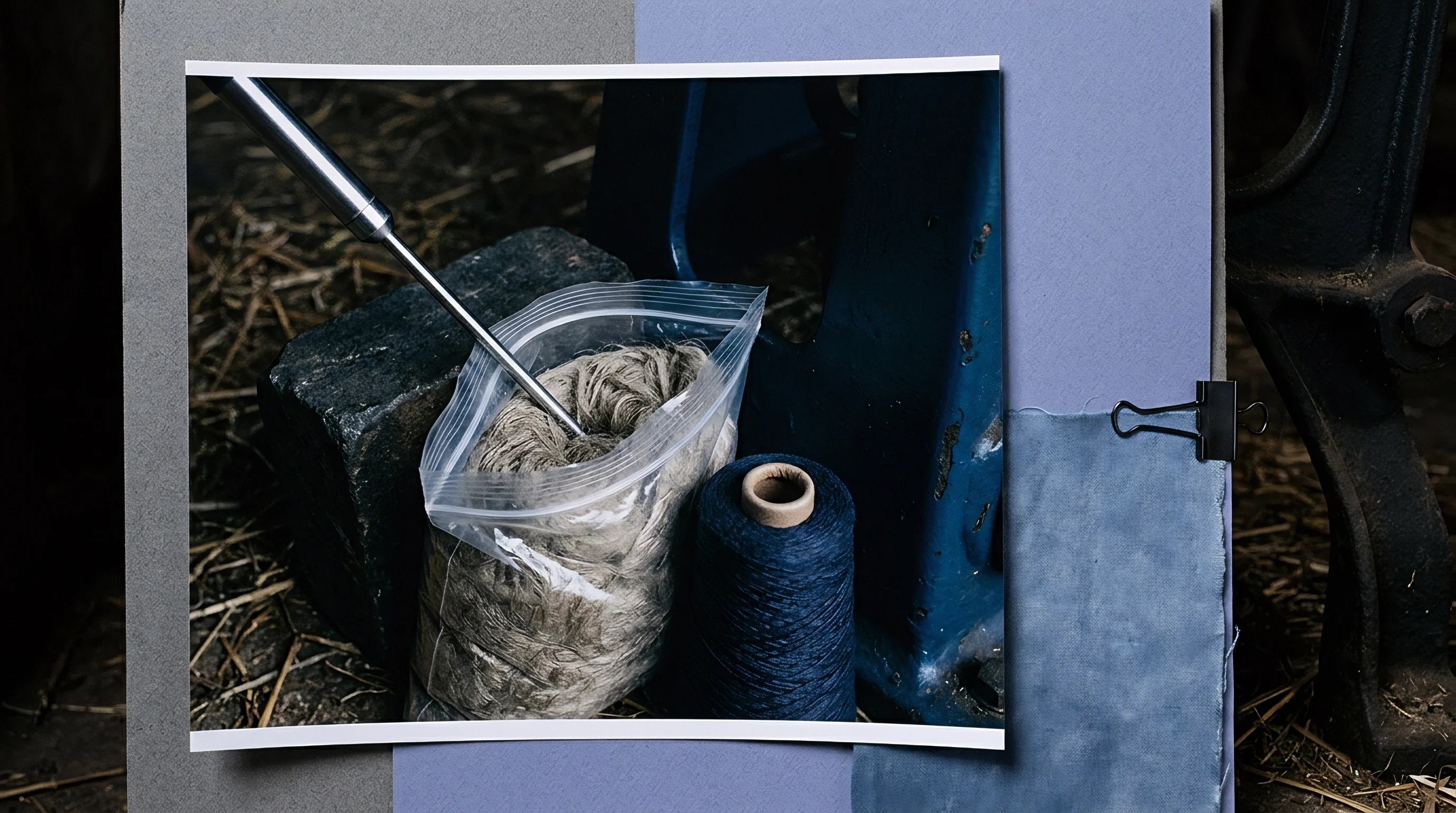
Geological Baselines across Primary Cultivation Zones
Western European flax growing regions along the English Channel coast sit atop specific geological formations. The Hercynian granitic and metamorphic basements of Brittany and Normandy deliver strontium-87 to strontium-86 ratios between 0.7120 and 0.7180. Cretaceous chalk and Cenozoic sedimentary basins across Flanders and Northern France yield lower ratios ranging from 0.7085 to 0.7098.
Soil sampling across the major European flax belt establishes an upper composite regional baseline bound tightly below 0.7140 for alluvial coastal plain harvests.
Flax cultivation in Northern East Asia occurs across geologically distinct terranes. Heilongjiang river basin soils overlie Quaternary volcanic flows and alluvial deposits from the Songliao basin, yielding bioavailable strontium ratios between 0.7055 and 0.7088. Xinjiang inland basin soils reflect continental evaporite weathering and arid erosion profiles, producing values from 0.7110 to 0.7165 depending on glacial runoff sources.
Importing mills blending raw fiber from multiple regions create composite signatures that sit outside single-origin soil corridors.
| Region | Geological Substrate | Typical Ratio Range (87Sr/86Sr) | Tissue Sr (ppm) | Tissue Sr/Ca Ratio (mmol/mol) |
|---|---|---|---|---|
| Normandy (France) | Cretaceous Chalk & Loess | 0.7088 – 0.7095 | 45 – 85 | 1.45 – 1.80 |
| Flanders (Belgium) | Cenozoic Marine Sediments | 0.7085 – 0.7092 | 50 – 90 | 1.50 – 1.85 |
| Brittany (France) | Hercynian Granitic Basement | 0.7130 – 0.7175 | 30 – 65 | 0.95 – 1.30 |
| Heilongjiang (China) | Quaternary Volcanic & Alluvium | 0.7058 – 0.7082 | 60 – 110 | 1.70 – 2.10 |
| Xinjiang (China) | Continental Evaporites & Silts | 0.7115 – 0.7160 | 85 – 140 | 2.10 – 2.65 |
Establishing true agricultural origin demands matching yarn tissue ratios against soil bioavailable fractions rather than total rock chemistry. Soil bioavailable strontium is extracted using ammonium acetate or dilute nitrate solutions to measure the mobile mineral pool accessible to flax root systems. Whole-rock acid digestions overestimate radiogenic ratios when refractory minerals resist natural weathering.
Laboratory verification protocols compare processed fiber digestions against geographic reference maps built exclusively from bioavailable soil extracts.
Fibre grown in ancient continental cratons carries elevated radio-isotope ratios compared to younger volcanic basins.
Unprocessed straw bundles retain soil-derived mineral ratios without alteration. The core crystalline structure of flax cellulose locks structural strontium into insoluble microfibril domains during tissue growth. Retting and mechanical scutching initiate the industrial transformation chain while preserving core plant chemistry.
Soil-to-plant transfer functions remain stable across climatic seasonal shifts, fixing the geological baseline of raw straw before wet processing introduces foreign minerals.


Bath
Retting water shifts surface balances. Field dew retting exposes harvested straw to ambient precipitation, soil contact, and fungal action on agricultural ground. Rainwater carries low mineral concentrations, causing minimal contamination of stem tissues.
Dam retting and river retting submerge flax stems in local surface waters, allowing dissolved minerals to absorb into porous outer bark and bark-pectin layers. Water retting operations introduce soluble strontium ions from process streams directly onto unretted fibre bundle surfaces.
Industrial spinning facilities subject scutched flax to intense aqueous chemical processing. Alkaline scouring removes waxes, residual pectins, and non-cellulosic impurities through boiling sodium hydroxide solutions. Hydrogen peroxide bleaching oxidizes natural pigments under elevated temperature and pH.
Dyeing sequences apply reactive or vat dyestuffs from aqueous liquors containing heavy salt loadings. Every wet stage forces mass exchange between process water minerals and binding sites inside the flax fibre matrix.

Are Process Water Minerals Masking True Fibre Origin?
Industrial scouring uses large volumes of municipal groundwater containing dissolved calcium and strontium ions. Strontium ions present in processing water replace loosely bound plant ions located in carboxylic acid groups of residual pectin. High mineral hardness in process water elevates surface strontium concentrations while pulling the bulk yarn isotopic signature toward local municipal water ratios.
Processing mills operating in regions with groundwater chemistry distinct from the fibre growth region systematically alter outer yarn isotopic signatures.
- Surface Adsorption mechanism deposits dissolved water minerals into outer cell wall structures during low-temperature retting rinses.
- Ion Exchange action replaces plant calcium with water-borne strontium inside pectin carboxyl complexes during hot alkaline boiling.
- Precipitation Deposition forces insoluble carbonate compounds to crystalize inside lumen cavities during hard-water bleaching cycles.
- Chemical Stripping removes bioavailable surface minerals through acid chelating washes, exposing core cellulose structural strontium.
Chemical processing removes non-structural strontium while preserving crystalline core cellulose fractions. Sequential chemical leaching separates surface-bound contaminants from deep cellulose matrices. Testing laboratories apply sequential extraction protocols using dilute acetic acid, ammonium acetate, and strong mineral acid digestions to isolate structural strontium from processing residue.
The ratio derived from the final crystalline cellulose digest aligns with agricultural soil signatures even after complete yarn bleaching and dyeing.
| Processing Stage | Total Sr Content (ppm) | Extractable Sr (%) | Isotopic Ratio (87Sr/86Sr) | Shift from Straw Baseline | |
|---|---|---|---|---|---|
| Raw Field Straw | 68.4 | 12.2 | 0.70912 | 0.00000 | |
| Dew Retted Line Flax | 65.1 | 10.8 | 0.70915 | +0.00003 | |
| Caustic Scoured Roving | 42.3 | 5.4 | 0.70938 | +0.00026 | |
| Bleached Grey Yarn | 28.6 | 2.1 | 0.70985 | +0.00073 | |
| Acid-Leached Cellulose Core | 18.2 | 0.2 | 0.70914 | +0.00002 |
Baking process water isotopic corrections into raw test data prevents incorrect origin rejection. Process water sampling logs recorded during yarn production quantify local groundwater ratios. When process water carries an isotopic ratio of 0.7125 and raw flax carries 0.7090, uncleaned bleached yarn displays an intermediate ratio proportional to total water-derived strontium loading.
Sequential extraction removes the 0.7125 component, restoring the verifiable 0.7090 baseline of the original crop field.
Standard ISO 17025 testing scope covers sequential chemical extraction to isolate core cellulose structural minerals from wet process contamination.
Mills frequently attribute isotopic shifts exclusively to municipal water variations during heavy rainfall without supplying process logs.


Digestion
Chemical breakdown of yarn takes place inside high-pressure fluoropolymer vessels to isolate elemental strontium. Analytical laboratory procedures demand complete mineralization of organic matrices to eliminate polyatomic interferences during mass spectrometry measurements. High-purity ultra-pure nitric acid combined with trace hydrogen peroxide dissolves yarn samples inside closed microwave digestion units at temperatures exceeding two hundred degrees Celsius.
Complete breakdown yields a clear, residue-free aqueous matrix containing dissolved trace metals.
Precise ratio measurement requires separating strontium from isobaric interferences present in the sample digest. Mass eighty-seven carries signals from both radiogenic strontium-87 and stable rubidium-87. Rubidium contamination distorts isotopic measurements, rendering origin determination impossible.
Specific chromatography resins containing crown ether extractant groups selectively retain strontium while allowing rubidium, calcium, and sodium matrix elements to pass into waste streams.
Isobaric Separation and Mass Spectrometry Execution
Rubidium interference at mass eighty-seven corrupts the target ratio unless chromatographic resin removes the alkali metal completely. Laboratory technicians wash packed column beds with concentrated nitric acid to elute residual rubidium prior to stripping strontium with ultra-pure water. Chromatographic separation efficiency is verified by monitoring rubidium-85 signals during mass spectrometry runs.
A rubidium-85 signal below baseline detection limits confirms complete isobaric separation.
- Microwave Acid Digestion breaks down organic cellulose chains using concentrated nitric acid inside sealed fluoropolymer pressure vessels.
- Crown Ether Chromatography isolates target divalent alkaline earth metals from monovalent alkali metals using selective ion-exchange resin beds.
- Isobaric Interference Correction monitors mass eighty-five intensity to calculate and subtract residual rubidium contribution from mass eighty-seven.
- Mass Bias Calibration standardizes raw instrument readings against repeated measurements of international isotopic standard reference materials.
Thermal Ionization Mass Spectrometry and Multi-Collector Inductively Coupled Plasma Mass Spectrometry provide the high precision necessary to resolve geographic origins. Thermal ionization instruments heat purified strontium nitrate on rhenium filaments, producing stable ion beams with minimal mass discrimination. Multi-collector plasma instruments deliver higher sample throughput by introducing liquid samples through nebulizer systems into argon plasma while using multiple Faraday cups to measure isotopes simultaneously.
To demonstrate calculation procedures, consider a 500-milligram yarn sample digested and processed through chromatographic isolation. Analytical screening reports total strontium yield at 15.2 micrograms with a residual rubidium-85 voltage of 0.00002 volts on the collector array. Mass bias correction follows an exponential law using stable strontium-88 to strontium-86 reference ratio of 8.37521.
The resulting corrected strontium-87 to strontium-86 ratio calculates to 0.70914 with an absolute internal precision of standard error 0.000012, placing the lot firmly within the Northern French coastal plain baseline.
Analysis of digestate yields a confirmed strontium-87 to strontium-86 ratio of 0.70914 under zero-rubidium blank conditions.
The field continues to debate whether sub-micron silica particles bound inside pectin microfibrils retain original soil ratios after aggressive caustic extraction.


Audit
Weighbridge records prove batch volume. Chain of custody verification requires matching physical yarn lots against agricultural production volumes, scutching delivery notes, and spinning mill batch logs. Isotopic testing functions as an audit tool inside a complete document verification schema.
A certified isotopic ratio offers limited legal defense when yarn shipping weights exceed the physical straw yields recorded at the scutcher.
Verification protocols begin at the spinning mill bale store. Auditors select physical yarn packages directly from production line creels rather than relying on pre-selected samples provided by mill management. Sampling strategies select five individual bobbins per metric ton of spun yarn, representing beginning, middle, and end positions of production runs.
Samples travel in sealed tamper-evident containers to accredited testing laboratories under strict chain-of-custody documentation.

Chain of Custody Reconciliation Protocol
Matching yarn shipment lot numbers against mill spinning logs establishes physical continuity before laboratory testing. Traceability files must connect raw fibre bale tags to specific wet-spinning frames, caustic boiling tanks, and yarn winding machines. Discrepancies between declared European fibre purchases and actual yarn output volume signal origin blending or undocumented fibre substitution.
- Verify physical raw material inventory against European Flax scope certificates and scutcher transaction certificates upon bale arrival at the spinning facility.
- Inspect daily spinning equipment allocation logs to confirm dedicated machinery runs for certified origin batches without cross-blending uncertified tow.
- Collect water samples from mill retting and wet-spinning bath supply lines to construct local process water isotopic reference profiles.
- Extract composite core-cellulose samples from finished yarn shipments and submit digestates for mass spectrometry ratio determination against declared growth region baselines.
| Test Finding | Document Status | Isotopic Deviation | Root Cause Analysis | Operational Action |
|---|---|---|---|---|
| Ratio matches field baseline | Certificates fully reconciled | Delta < 0.0003 | Authentic single-origin crop lot | Release shipment for commercial use |
| Ratio shifts toward mill water | Certificates fully reconciled | Delta 0.0004 – 0.0012 | Surface process water contamination | Mandate acid-leach cellulose re-test |
| Ratio matches secondary region | Transaction volume mismatch | Delta > 0.0025 | Undocumented fibre substitution | Reject shipment origin declaration |
| Ratio exhibits wide variance | Gaps in spinning lot records | Variable across bobbins | Physical blending of raw fibres | Downgrade lot to non-preferential status |
Lab certificates bind the seller. Incorporating isotopic compliance parameters directly into yarn procurement contracts prevents downstream commercial disputes. Contracts define acceptance bands based on pre-mapped agricultural base ratios plus maximum allowable tolerances for process water interactions.
Mill qualification depends on passing random verification audits across consecutive yarn shipments over the production calendar.
Documented mass balance reconciliation prevents uncertified fibre insertion prior to chemical testing.
Standard origin warranty clause 14-B shifts all testing expenses and import tariff adjustments onto the mill whenever mass spectrometry values diverge from declared field baselines.


Claim
Customs authorities impose severe financial penalties on misdeclared origin certificates. Non-preferential origin rules require yarn to undergo substantial transformation in declared manufacturing countries. Preferential origin frameworks require proof of crop harvesting within designated trade agreement zones.
Isotopic ratio verification provides objective analytical proof that overrides paper documentation during customs audits and anti-circumvention investigations.
Origin surcharges raise landed costs. Premium European flax fibre commands significant price surcharges per kilogram over standard Asian tow. Blending lower-cost uncertified tow into certified line flax spinning lots preserves profit margins for unscrupulous processors while defrauding downstream buyers.
Isotopic screening detects low-level blending of uncertified fibre, protecting buyers from paying certified price premiums for substituted materials.

Commercial Origin Guarantees and Liability Transfer
Purchase orders incorporating mandatory isotopic compliance clauses force spinning mills to absorb customs reclassification costs. Buyers specify that testing results outside approved isotopic geographic corridors trigger immediate commercial remedies. Remedies include full batch rejection, forfeiture of performance bonds, and reimbursement of financial penalties levied by destination customs administrations.
Unverified claims fail customs entry. Importing businesses facing origin challenges must present complete technical dossiers to customs enforcement authorities. The dossier contains independent laboratory isotope test reports, sequential extraction analysis logs, regional soil baseline comparison data, and verified mill process water profiles.
Presenting rigorous isotopic data establishes due diligence, mitigating administrative fines and preventing asset seizure at import ports.
Batch testing protects total margin. Implementing systematic isotopic screening across incoming yarn shipments adds modest testing costs per metre of finished fabric while securing compliance across high-value retail collections. Establishing verifiable scientific proof of crop origin secures brand integrity, satisfies regulatory trace demands, and eliminates commercial risk across international textile supply chains.
Failing to verify isotopic ratios prior to customs clearance leads to immediate shipment seizure, back-duty penalties, and commercial disqualification across regulated import markets.