Extrapolation Model Kinetics for Cellulose Polymer Degradation in Continuous Chemical Baths
Continuous cellulose degradation obeys Ekenstam depolymerization kinetics; maintaining DP above 600 requires strict bath temperature and turnover management.

Scission
Cleavage of cellobiose repeating units along the cellulosic backbone governs the physical degradation rate during continuous wet processing. In aqueous chemical baths, the long-chain macromolecule suffers hydrolysis or oxidative chain cleavage depending on thermal energy, hydrogen ion concentration, and reactant activity. Continuous processing ranges subject linen yarn to constant chemical exposure, where reaction kinetics deviate from static batch operations due to mechanical agitation and steady-state chemical replenishment.

Mathematical Foundations of Polymer Chain Cleavage
Depolymerization kinetics in continuous liquid media follow the Ekenstam relation for random scission along linear polymer chains. Assuming each glycosidic linkage possesses equal reactivity, the rate of bond cleavage remains proportional to the number of intact glycosidic bonds present within the continuous treatment vessel. The kinetic expression equates the reciprocal of the number-average degree of polymerization at time t minus the reciprocal of the initial degree of polymerization to the zero-order rate constant multiplied by exposure time.
(1 / DPt) – (1 / DP0) = k · t
Chemical processing in alkaline media introduces additional degradation pathways. B-elimination reactions target cellobiose units containing oxidized hydroxyl groups, cleaving the polymer chain at lower thermal thresholds than pure hydrolytic cleavage. Acidic baths hydrolyze the 1,4-beta-glycosidic bonds directly.
Protonation of the glycosidic oxygen forms a conjugate acid, followed by slow heterolytic cleavage to generate a carbonium ion and an oligomeric fragment.
Alkaline hydrogen peroxide baths operating at pH 11.5 and 95 degrees Celsius accelerate cellulose chain cleavage by a factor of 4.2 for every 10-degree thermal increment.

Thermal and Chemical Activation Boundaries
Activation energy dictates how sharply scission rates react to thermal spikes within continuous processing machinery. Hydrolytic cleavage under acidic conditions exhibits an activation energy range between 110 and 140 kilojoules per mole. Alkaline degradation mechanisms display activation energy values between 100 and 125 kilojoules per mole.
Extrapolating laboratory kinetic data from short-duration high-temperature trials to continuous mill production requires accounting for mass transfer resistance at the liquid-yarn interface.
Continuous baths alter local concentration gradients. Stagnant fluid layers surrounding moving yarn bundles retard reagent diffusion, causing localized variations in rate constants. Mechanical tension applied during continuous transport aligns crystalline domains, which alters the relative accessibility of amorphous regions to chemical attack.
| Bath Chemistry | pH Range | Temperature Range (°C) | Rate Constant k (min⁻¹) | Activation Energy (kJ/mol) |
|---|---|---|---|---|
| Sulfuric Acid Reduction | 1.5 – 2.5 | 60 – 85 | 1.2 × 10⁻⁵ | 128.5 |
| Sodium Hydroxide Mercerization | 13.0 – 14.0 | 15 – 25 | 4.5 × 10⁻⁷ | 102.1 |
| Alkaline Hydrogen Peroxide Bleach | 10.5 – 11.8 | 85 – 98 | 8.9 × 10⁻⁵ | 115.4 |
| Sodium Hypochlorite Oxidation | 9.0 – 10.0 | 35 – 50 | 3.1 × 10⁻⁴ | 94.8 |
Industrial processing runs maintain fixed chemical charges over extended operational shifts. When continuous ranges process heavy linen substrates, local consumption of active chemical species generates localized concentration depressions. Extrapolation models that omit fluid shear dynamics over-predict depolymerization rates by failing to register reactant depletion within the core of dense yarn bundles.
- Hydrolytic Scission Rate Proton concentration determines the rate of glycosidic cleavage within acidic desizing and reduction baths.
- Oxidative Scission Rate Hydroxyl radical activity drives non-specific chain cleavage within unstabilized peroxide bleaching liquors.
- Beta Elimination Rate Carbonyl group concentration along the cellulose backbone accelerates chain cleavage under alkaline conditions.
- Diffusion Limited Rate Liquid velocity through the yarn assembly governs chemical transport into crystalline cellobiose domains.
Determining whether localized shear stress accelerates scission kinetics beyond pure thermal activation remains an unresolved issue in high-velocity continuous finishing machinery.


Viscosity
Capillary viscometry provides the standard analytical benchmark for quantifying molecular degradation in processed cellulose. Dissolving harvested yarn samples into organometallic solvent complexes isolates individual cellulose chains for hydrodynamic volume determination. Intrinsic viscosity values correlate directly with molecular weight, serving as the primary input for depolymerization kinetic models.
Solvent Dissolution and Capillary Measurement
Cupriethylenediamine hydroxide solution dissolves raw and processed flax fibers without inducing additional degradation when isolated from atmospheric oxygen. Standard protocol ISO 5351 specifies dilute-solution viscometry using Ubbelohde capillary tube viscometers held within precision water baths at 25 degrees Celsius. Efflux time measurements for the pure solvent and the polymer solution yield specific viscosity figures, which reduce to intrinsic viscosity through the Huggins extrapolation equation.
= limc to 0 fracηspc
Atmospheric oxygen entering the dissolution vessel induces rapid autoxidation of dissolved cellulose chains in alkaline copper solvents. Purging dissolution flasks with high-purity nitrogen gas prevents artificial scission during preparation. Flax fibers containing residual lignin or hemicellulose demand specialized pre-extraction protocols to prevent insoluble residues from clogging capillary lumens during efflux timing cycles.
Exposure to atmospheric oxygen during cupriethylenediamine dissolution invalidates the intrinsic viscosity measurement by introducing artificial oxidative cleavage.
Translating Intrinsic Measurements to DP Values
Mark-Houwink-Sakurada parameters convert intrinsic viscosity figures into viscosity-average degree of polymerization. For cellobiose polymers dissolved in cupriethylenediamine, the empirical constants K and a equal 1.33 mL/g and 0.905 respectively across standard temperature ranges. Shifts in these empirical constants alter calculated degree of polymerization values, requiring rigorous standardized calibration across testing facilities.
- Dry the processed linen sample to constant mass at 105 degrees Celsius inside a desiccator.
- Weigh exactly 100 milligrams of dried fiber on an analytical balance reading to four decimal places.
- Transfer the weighed fiber into a dark glass dissolution bottle fitted with a rubber septum cap.
- Evacuate atmospheric air from the bottle using a vacuum pump and flush with oxygen-free nitrogen gas.
- Inject 25.0 milliliters of 0.5 molar cupriethylenediamine solution through the septum using a glass syringe.
- Agitate the bottle on a mechanical shaker for 30 minutes until full fiber dissolution occurs.
- Transfer the solution to an Ubbelohde viscometer mounted in a water bath controlled to 25.0 degrees Celsius.
- Measure the efflux time between calibration marks using an electronic timer accurate to 0.01 seconds.
Degree of polymerization metrics drop exponentially during aggressive continuous bleaching cycles. Raw flax cellulose typically demonstrates initial degree of polymerization figures between 2000 and 2800 units. Full commercial processing reduces these numbers to operational target bands between 800 and 1200 units.
Values falling below 600 units indicate severe structural damage, rendering yarn vulnerable to mechanical failure during high-speed weaving operations.
Consistent capillary cleaning prevents solvent contamination between continuous process audits.

Turnover
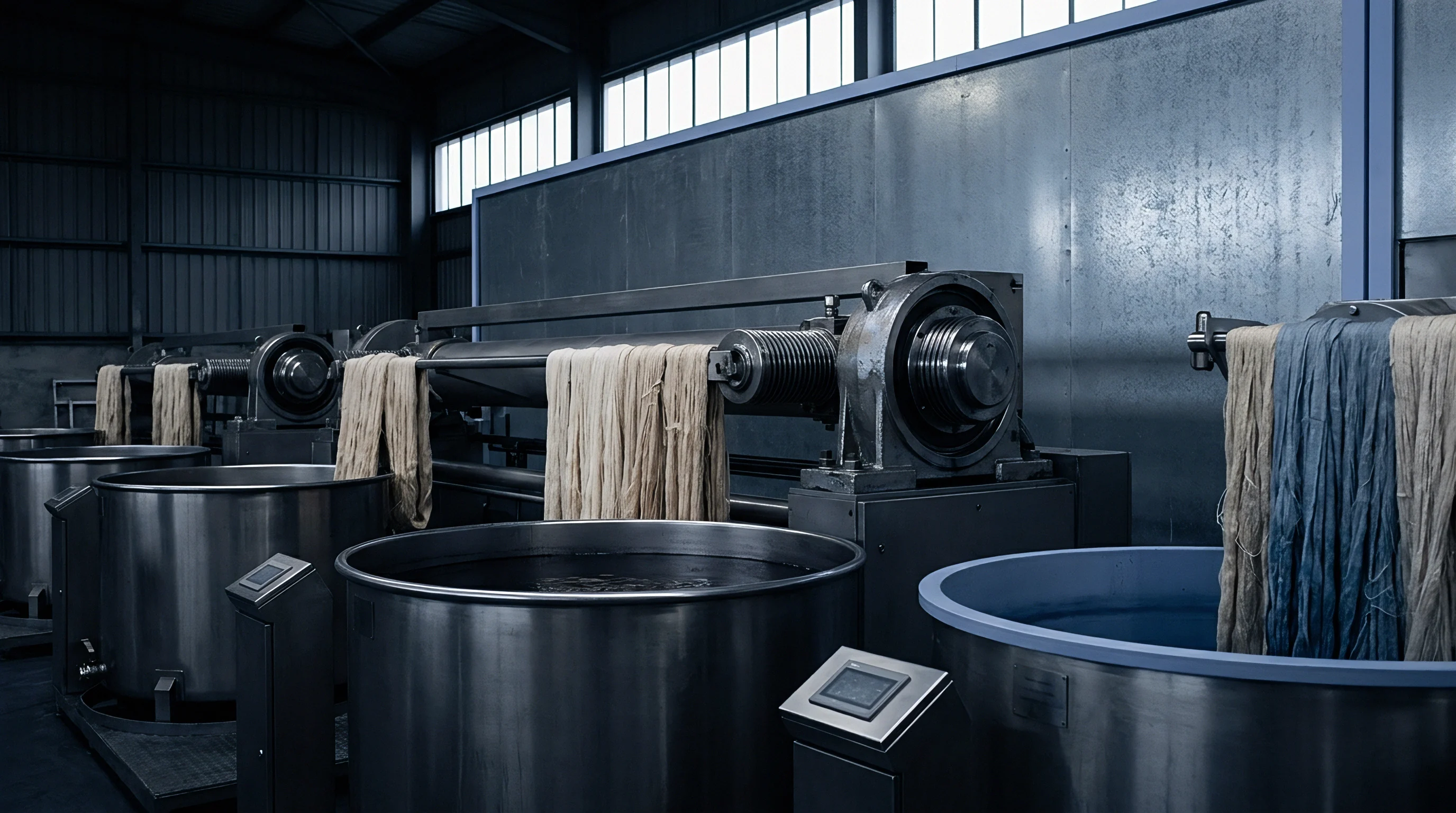
Fluid exchange dynamics within continuous chemical processing tanks determine the rate of reagent replenishment and chemical byproduct removal. Bath turnover ratios compare incoming liquid feed rates against total fluid volume contained within the processing tank. High turnover rates maintain uniform bath concentration profiles, whereas low turnover ratios create stagnant zones where degradation reactions proceed unpredictably.

Liquor Ratio Dynamics and Chemical Replenishment
Continuous ranges operate at liquor ratios ranging from 3:1 to 10:1 per weight of processed textile substrate. Low liquor ratios conserve water and thermal energy but concentrate degradation byproducts. Dissolved cellobiose oligomers, organic acids, and extracted pectins accumulate within the working liquor over long operational shifts, altering bath pH and chemical activity.
Replenishment dosing systems inject concentrated chemical feeds to balance consumption caused by yarn absorption and chemical reaction. Dosing logic relies on continuous sensor feedback for pH, oxidation-reduction potential, and bath temperature. Malfunctioning feed pumps cause cyclic concentration swings, subjecting passing yarn lots to non-uniform chemical degradation.
| Process Stage | Liquor Ratio (L:kg) | Bath Replenishment Rate (L/min) | Fluid Shear Velocity (m/s) | Target DP Loss per Hour (%) |
|---|---|---|---|---|
| Continuous Alkaline Scour | 4:1 – 6:1 | 45.0 | 1.2 | 2.1 – 3.5 |
| High-Speed Peroxide Bleach | 3:1 – 5:1 | 60.0 | 2.0 | 4.8 – 7.2 |
| Acid Reduction Wash | 6:1 – 8:1 | 30.0 | 0.8 | 1.5 – 2.8 |
| Causticization Neutralization | 8:1 – 10:1 | 80.0 | 1.5 | 0.5 – 1.2 |
Liquid displacement inside dense yarn structures depends on fluid shear velocity. External bath agitation drives fresh liquor through the yarn interior, replacing spent chemical species. Insufficient liquid exchange creates localized concentration peaks where degraded cellobiose fragments undergo secondary oxidation, forming aggressive organic radical intermediates.
High liquor velocity through the fabric matrix reduces localized degradation spikes by suppressing stagnant boundary layer formation.
Catalytic Impurity Accumulation in Continuous Loops
Recirculating liquor systems retain heavy metal ions extracted from raw flax fibers or incoming process water. Trace concentrations of iron, copper, and manganese catalyze the decomposition of hydrogen peroxide into highly reactive hydroxyl radicals. Uncontrolled radical production induces non-selective chain scission along the cellulose backbone, accelerating depolymerization rates far beyond predicted kinetic models.
Sequestration agents added to continuous bath chemistry bind transition metal ions to neutralize catalytic activity. Polyphosphonates and aminocarboxylates form stable complexes with iron and copper ions under alkaline conditions. Inadequate chelating dosage allows catalytic cycles to proceed, resulting in localized pinhole damage and severe yield losses across continuous production lots.
Failure to maintain sequestration agent concentration leads directly to catalytic pinhole formation and widespread strength loss across entire production runs.


Tenacity
Physical strength loss tracks polymer depolymerization through precise mechanical testing of yarn bundles and woven cloth. Tensile properties reflect the collective structural integrity of crystalline microfibrils held together by amorphous cellulosic domains. Chain scission within amorphous zones degrades inter-crystalline load transfer, reducing ultimate tensile strength before macroscopic fiber damage becomes visible under microscopy.

Molecular Weight Decay and Mechanical Breakage
Breaking force correlates with number-average degree of polymerization via non-linear relationships. Initial drops in degree of polymerization from 2500 down to 1400 units produce minimal impact on tensile strength, as remaining chain lengths exceed the critical entangling threshold. Further degradation below 800 units causes rapid strength decay, as short polymer chains slip past one another under mechanical tension rather than bearing applied tensile loads.
ISO 13934 strip test standards and ASTM D5034 grab test procedures register physical strength loss across warp and weft yarn systems. Standardized testing requires conditioning specimens at 20 degrees Celsius and 65 percent relative humidity for 24 hours prior to pull testing. Failure to condition samples yields distorted strength values due to the plasticizing effect of absorbed atmospheric moisture on cellulosic polymers.
Flax fibres exhibit precipitous strength decay when average degree of polymerization drops below the critical threshold of six hundred.

Worked Calculation of Strength Loss over Continuous Dwell Time
Consider a continuous bleaching range operating at 92 degrees Celsius with a yarn transport speed yielding a bath dwell time of 45 minutes. Initial unbleached linen yarn possesses an average degree of polymerization of 2100 units and an initial single-yarn tensile strength of 18.5 centinewtons per tex. Laboratory kinetic calibration establishes a zero-order depolymerization rate constant of 1.8 × 10⁻⁶ min-1 under continuous bath conditions.
Calculating the final degree of polymerization after 45 minutes using the Ekenstam relation:
(1 / DP45) = (1 / 2100) + (1.8 × 10-6 × 45)
(1 / DP45) = 0.00047619 + 0.00008100 = 0.00055719
DP45 ≈ 1795 units
Assuming empirical calibration links strength loss to degree of polymerization via the linear decay approximation within high DP bands:
Tfinal = Tinitial ·
Where empirical transfer coefficient α = 0.00035 unit-1 for processed flax fibers:
Tfinal = 18.5 ·
Tfinal = 18.5 · = 16.53 cN/tex
Extending dwell time to 120 minutes under identical bath conditions drops degree of polymerization down to 1445 units, reducing tensile strength to 14.26 centinewtons per tex. Processing beyond target dwell limits leads directly to rejected yarn lots at weaving preparation stages.

What Triggers Accelerational Tensile Loss in Bleached Flax?
Thermal excursions exceeding operational setpoints represent the primary trigger for rapid strength loss. A 5-degree rise in continuous peroxide bath temperature increases kinetic rate constants by roughly 50 percent, driving degree of polymerization values into the steep strength-loss zone. Additional factors include uncontrolled acidification during washing, non-uniform tension across continuous transport rollers, and localized drying non-uniformities.
Mills often claim that strength losses stem entirely from raw fiber variability rather than continuous bath management failures.

Softener
Topical lubricating agents mask underlying structural damage caused by excessive continuous chemical degradation. Amino-functional silicone fluids, macro-emulsions, and fatty acid condensation products coat fiber surfaces, reducing fiber-to-fiber friction coefficients. Low surface friction allows degraded yarn bundles to slip smoothly during tensile pull testing, artificially boosting measured breaking force figures during initial quality control inspections.

Chemical Masking of Polymer Structural Damage
Softening agents pad onto woven cloth during final finishing stages, masking depolymerization produced during upstream bleaching and scouring operations. Lubricated fibers re-align under mechanical load, distributing applied force across multiple yarn elements simultaneously. Initial tensile testing reveals normal breaking force values despite severely reduced cellulose degree of polymerization values within the fiber core.
Standard quality verification protocols demand multiple detergent wash cycles to strip topical softeners before conducting mechanical or viscometric testing. ISO 6330 laundering procedures at 60 degrees Celsius remove non-reactive silicone lubricants and surface waxes. Testing washed specimens exposes true physical strength decay and unveils high depolymerization rates previously concealed by chemical finishing.
| Sample State | Mean DP (ISO 5351) | Grab Tensile Strength (N) | Elongation at Break (%) | Tear Strength (N) |
|---|---|---|---|---|
| Unbleached Control Yarn | 2250 | 480 | 3.8 | 32.5 |
| Over-Bleached Unfinished Cloth | 540 | 210 | 1.9 | 12.0 |
| Over-Bleached + Silicone Softener | 540 | 395 | 3.4 | 24.8 |
| Over-Bleached + 5 ISO 6330 Washes | 535 | 225 | 2.0 | 13.1 |
| Over-Bleached + 20 ISO 6330 Washes | 530 | 205 | 1.8 | 11.4 |
Topical lubrication provides temporary friction reductions without repairing severed glycosidic chains inside the cellobiose polymer matrix. Repeated laundering removes surface coatings, causing progressive drop-offs in tear resistance and seam strength during customer use cycles.

Contractual Risk and Post-Wash Verification
Sourcing documentation must specify post-wash mechanical testing requirements to defend procurement budgets against chemical masking tactics. Standard commercial clauses require all physical performance limits to be met after five consecutive standardized laundering cycles. Audit verification checks intrinsic viscosity alongside mechanical strength to ensure chemical degradation limits are respected.
- Unwashed Strength Threshold Initial mechanical testing must establish baseline breaking force figures prior to finishing additions.
- Post Laundry Retained Tenacity Samples subjected to five standardized wash cycles must retain at least eighty-five percent of initial tensile strength.
- Viscosity Floor Requirement Intrinsic viscosity measured under ISO 5351 must not drop below 450 milliliters per gram across any finished lot.
- Softener Extraction Check Solvent extraction using hot ethanol must precede viscometric testing to isolate pure cellulosic fiber material.
Purchase contracts carrying standard non-conformance penalties specify that any lot failing post-wash tensile thresholds subject the supplier to full inventory rejection and landed-cost indemnification.


Penalty
Financial liabilities associated with chemical degradation fall directly onto processing mills that fail to manage continuous bath kinetics. When delivered cloth fails contract viscosity or post-wash tenacity specifications, buyers face inventory write-downs, garment manufacturing delays, and downstream customer rejections. Establishing clear commercial chargeback structures ensures that chemical damage costs translate into quantifiable contract remedies.
Commercial Chargeback Calculations for Degraded Goods
Financial recovery formulas calculate chargebacks by combining direct fabric scrap values, freight losses, and secondary processing costs. If a 10,000-meter lot of processed linen demonstrates an average degree of polymerization of 480 units against a contract floor of 750 units, the material experiences severe structural degradation. The buyer enforces a tiered penalty schedule based on documented degree of polymerization deficit percentages.
Landed cost adjustments scale exponentially with degradation severity. Minor deficits trigger unit price discounts intended to compensate for reduced garment wear life. Severe depolymerization crossing critical strength thresholds requires full lot rejection, with the processing mill bearing freight, customs duty, and disposal costs.

Audit Evidence Standards for Origin and Process Warranties
Defending financial claims during cross-border trade disputes demands comprehensive audit trails connecting laboratory test results to mill production logs. Scope certificates issued under international scheme rules confirm origin attributes but do not guarantee physical structural integrity. Buyers must combine origin documentation with lot-specific viscometry reports and continuous bath logging records.
Independent testing laboratories operating under ISO 17025 accreditation provide legally binding verification reports. Sampling protocols require taking representative swatches from the head, middle, and tail of every continuous production roll. Discrepancies between mill-supplied test certificates and independent laboratory audits establish legal grounds for contractual breach claims.
Chain-of-custody documentation tracing European Flax fiber through Chinese spinning and continuous bleaching operations requires matching mass balance ledgers with chemical logbooks. If continuous bath speed logs indicate line speeds exceeding verified kinetic dwell limits, customs authorities and buyers reject process compliance declarations. Precise kinetic extrapolation modeling gives buyers the analytical foundation needed to reject sub-standard continuous processing lots before final commercial settlement.