Coupled Thermal and Vapour Diffusion Modeling across Compressed Bast Fibres
Coupled heat and vapour diffusion models predict internal bale moisture spikes, protecting raw flax purchase weights and hackling yields.


Density

Anisotropic Packing and Porosity in Scutched Bales
Compressed bast fibre packages exhibit complex transport phenomena governed by structural anisotropy and variable packing arrangements. Hydraulically consolidated scutched flax bales reaching mass densities between 150 kg/m³ and 380 kg/m³ alter the spatial distribution of void spaces. High mechanical forces orient individual long-staple fibres primarily perpendicular to the direction of pressing.
This alignment creates directional permeability channels inside the compressed matrix. Parallel to the fibre direction, gas-phase water vapour moves with minimal tortuosity. Transverse to the fibre axis, vapour diffusion encounters dense cellular barriers, significantly increasing pathway tortuosity.
Internal void fraction decreases as bulk compression increases. At a density of 180 kg/m³, inter-fibre spaces dominate total pore volume, enabling Knudsen and continuum diffusion regimes to operate simultaneously. Elevating bale density to 320 kg/m³ collapses macro-pores, compressing void diameters below one micrometre.
Under these conditions, collisions between water vapour molecules and cell wall surfaces dominate molecular transport. Porosity reductions directly alter effective thermal conductivity. Dry plant cell wall substance carries a thermal conductivity of approximately 0.45 W/(m·K), whereas entrapped dry air conducts at 0.026 W/(m·K).
Compacting the fibre mass increases conduction pathways through solid cell walls while diminishing insulating air pockets.
At a compressed density of 320 kg/m³ under standard testing conditions, radial vapour permeability declines by 64 percent compared to loose scutched stock.

Mass Distribution and Compression Vectors
Industrial baling equipment introduces density gradients across the geometry of a single unit package. Hydraulic rams exert maximum compressive stress near the outer pressing faces, creating dense surface layers. Central regions of high-tonnage bales often maintain lower packing densities due to internal friction between entangled flax ribbons.
Density gradients drive regional variations.
Variable packing alters local moisture transport rates. Regions exceeding 350 kg/m³ experience delayed vapour diffusion, locking absorbed water into central core zones. When external ambient relative humidity drops, surface layers desorb moisture rapidly while the core remains saturated.
Moisture migration alters local weight. Discrepancies between core and surface moisture levels complicate net commercial weight calculations during trade disputes.
Failure to account for non-uniform density distributions in transport models leads to inaccurate predictions of moisture equilibration times, causing unexpected mould growth in dense bale cores during transit.

Flux

Transient Heat Transfer and Bound Water Desorption
Simultaneous transfer of energy and vapour through compressed flax matrices involves coupled thermodynamic mechanisms. Heat moves through solid cellular walls by conduction and across pore voids by micro-convection and radiation. Vapour diffuses through inter-fibre air voids while bound water migrates along cell wall surfaces via concentration-driven surface diffusion.
Temperature gradients within a bale force localized phase changes. Absorbed liquid water inside cell walls desorbs into vapour when local temperatures rise, consuming latent heat of vaporization. Vapour migrates along pressure gradients toward cooler regions where it condenses, releasing latent heat back into the fibre bed.
Heat transfer accelerates vapour migration. Elevated core temperatures raise saturation vapour pressure, generating internal partial pressure gradients that drive moisture outward. Conversely, external heat application causes moisture to migrate inward if surface layers dry rapidly and create a opposing thermal diffusion vector.
Moisture transport kinetics depend heavily on local fibre compaction.

Does Bulk Compression Alter Bound Water Transport Kinetics?
Compaction forces individual bast fibre bundles into intimate physical contact, altering molecular water transport pathways. Hydroxyl binding sites on cellulose and hemicellulose chains interact directly with sorbed water molecules. At lower compression levels, water molecules hop between adjacent sorption sites along the cell wall surface.
Higher compression reduces the distance between neighboring fibre surfaces, facilitating cross-fibre liquid migration without requiring complete evaporation into inter-fibre void space.
Bound water transport rates increase when contact pressure bridges adjacent bundles. Surface diffusion coefficients for bound water range from 10⁻¹³ m²/s to 10⁻¹¹ m²/s depending on local moisture content and temperature. Inter-fibre diffusion coefficients drop as pore dimensions shrink.
Compaction shifts the dominant moisture transport mechanism from vapour diffusion across voids to surface migration across contacting cell walls. Cold air triggers rapid condensation.

Governing Transport Equations for Porous Media
Mathematical formulations describing coupled heat and vapour transport rely on conservation equations for mass and energy within a representative elementary volume. Mass conservation incorporates local moisture content changes, vapour flux gradients, and liquid flux terms. Energy conservation balances sensible heat storage, thermal conduction, and latent heat generation from sorption dynamics.
Coupling terms link vapour flux to thermal gradients through thermo-diffusion and heat flux to concentration gradients through the Dufour effect.
Transport parameters vary significantly across compression densities, as detailed in the technical baseline below.
| Density (kg/m³) | Porosity (-) | Thermal Conductivity Axial (W/m·K) | Thermal Conductivity Radial (W/m·K) | Effective Vapour Diffusion (m²/s) |
|---|---|---|---|---|
| 150 | 0.90 | 0.052 | 0.038 | 1.8 × 10⁻⁵ |
| 220 | 0.85 | 0.068 | 0.046 | 1.1 × 10⁻⁵ |
| 280 | 0.81 | 0.084 | 0.055 | 6.4 × 10⁻⁶ |
| 340 | 0.77 | 0.102 | 0.064 | 3.2 × 10⁻⁶ |
Execution of accurate field moisture audits requires a systematic sampling sequence. Technologists employ the following standard sequence during bale arrival inspections:
- Verify outer bale strapping integrity and measure external dimensions to calculate total volumetric space.
- Insert calibrated core temperature probes to a minimum depth of three hundred millimetres from the pressing face.
- Extract core fibre samples using a sealed hollow drill core bit operating at low rotational velocity to avoid frictional heating.
- Transfer core specimens immediately into gas-tight aluminum containers to prevent atmospheric moisture exchange.
- Weigh sealed specimens before and after oven drying at 105 degrees Celsius according to standard laboratory conditioning rules.
Compliance with ISO 6741 commercial mass determination requires thermal stabilization within 0.5 degrees Celsius before taking final tare mass.
Contractual disputes regarding delivered weight fall under ISO 6741 criteria, which enforce specific atmospheric conditioning windows and prohibit commercial invoice settlement based on uncalibrated capacitance probe measurements taken through outer bale wrapping.

Enthalpy

Sorption Thermodynamics and Latent Heat Accumulation
Energy transitions within dense bast fibre packages dictate internal temperature swings during maritime shipping. Flax cell walls absorb water vapour through an exothermic reaction. The total heat of sorption combines the latent heat of condensation of free water with the differential heat of sorption specific to cellulose hydroxyl binding.
At low moisture regain levels below four percent, differential heat of sorption reaches 800 kJ per kilogram of water sorbed. As moisture content increases toward saturation, differential sorption energy drops toward zero, leaving only latent heat of condensation at approximately 2260 kJ per kilogram.
Consider a 200 kg flax bale compressed to a density of 250 kg/m³ with an initial uniform regain of 8.0 percent. If atmospheric moisture penetrates the package during shipping, raising core regain to 12.0 percent, 8.0 kg of water vapour undergoes phase transition into bound water inside the core. Assuming an average combined differential heat and latent heat of 2600 kJ per kg of sorbed water, the process releases 20,800 kJ of thermal energy.
Given a specific heat capacity of dry flax of 1.25 kJ/(kg·K) and sorbed water at 4.18 kJ/(kg·K), the overall heat capacity of the moist fibre mass equals approximately 280 kJ/K. Thermal energy dissipation is slow. Unchecked sorption raises core temperature by tens of degrees Celsius.
| Initial Regain (%) | Final Regain (%) | Water Sorbed (kg) | Total Energy Released (kJ) | Adiabatic Core Temp Rise (°C) |
|---|---|---|---|---|
| 6.0 | 10.0 | 8.0 | 21,400 | 78.2 |
| 8.0 | 12.0 | 8.0 | 20,800 | 74.3 |
| 10.0 | 14.0 | 8.0 | 19,600 | 68.5 |
| 12.0 | 16.0 | 8.0 | 18,400 | 62.8 |
Core temperature spikes during ocean transit indicate active vapour condensation rather than external ambient heating.

Exothermic Moisture Absorption Risks during Transit
Self-heating events occur when ambient air with elevated relative humidity enters containerized freight holding cold-packed flax bales. Condensation forms on bale surfaces, initiating rapid local sorption. Dry cores resist heat dissipation.
Low transverse thermal conductivity traps generated heat inside the package interior.
Bale core probe records fifty degrees. Local heating accelerates micro-biological activity, causing fungal growth and cellulose wall hydrolysis. Fungal activity generates additional metabolic heat and moisture, accelerating structural damage.
Pectic degradation reduces fibre length.
Suppliers frequently claim that thermal spikes in delivered bales stem entirely from ambient engine room heat transfer rather than internal moisture condensation inside high-density packages.


Hysteresis

Adsorption and Desorption Isotherm Variance
Equilibrium moisture content paths diverge depending on whether flax fibres gain or lose water from the surrounding atmosphere. Desorption curves sit consistently above adsorption curves across the full relative humidity range. At sixty-five percent relative humidity and twenty degrees Celsius, a desorbing flax fibre retains approximately 9.5 percent moisture regain, while an adsorbing fibre reaches equilibrium at 7.8 percent regain.
This hysteresis gap stems from structural molecular rearrangements within amorphous cellulose and hemicellulose regions.
Compaction narrows the hysteresis loop by constraining swelling capability within cell walls. When fibre bundles are compressed under high tonnage, internal void spaces collapse, physically restricting the expansion of amorphous polymer chains. Molecular sorption sites remain occluded or unavailable for incoming water molecules.
Non-uniform moisture equilibrium creates downstream process failures across yarn spinning floors:
- Drafting force fluctuations occur during drawing operations when adjacent fibre bundles carry uneven bound water content, causing variations in sliver linear density.
- End breakage spikes emerge at wet-spinning frames due to localized weak spots where un-equilibrated fibres fail under drafting tension.
- Uneven dye uptake affects finished yarns because amorphous region swelling dictates dye molecule accessibility into cellulose matrix networks.
- Spontaneous mold formation develops in packed storage areas where desorbing zones maintain micro-environments exceeding critical water activity thresholds.

Fibre Cell Wall Swelling Dynamics
Dimensions of individual lumen structures shift during water uptake. Bast fibres swell anisotropically upon absorbing moisture. Radial expansion reaches up to fifteen percent, whereas axial elongation along the fibre direction remains below one percent.
In a highly compressed bale, radial swelling is constrained by outer steel or polypropylene strapping.
Internal mechanical stress increases as fibres attempt to swell against rigid outer boundaries. Swelling pressure against bale ties can exceed five megapascals. This pressure further reduces inter-fibre porosity, reducing vapour diffusion coefficients during conditioning cycles.
How does constrained transverse cell wall expansion permanently alter crystalline cellulose orientation in compressed bast fibre bundles?


Calibration

Finite Element Numerical Discretization
Predictive physical models require experimental parameter identification under controlled atmospheric environments. Discretizing coupled non-linear differential equations across dense three-dimensional bale geometries demands fine spatial meshes near external boundaries where steep moisture and temperature gradients develop. Transient boundary conditions model heat transfer through convection and radiation alongside mass transfer governed by surface mass transfer coefficients.
Implicit time-stepping algorithms ensure numerical stability when solving strongly coupled thermal and vapour equations. Sharp moisture fronts moving through compressed zones generate stiff matrix equations. Convergence criteria must monitor mass and energy conservation residuals simultaneously to avoid numerical drift.
Industrial microwave attenuation sensors measure volumetric water content faster than core pin electrodes in dense flax packages.
Laboratory Validation Methods
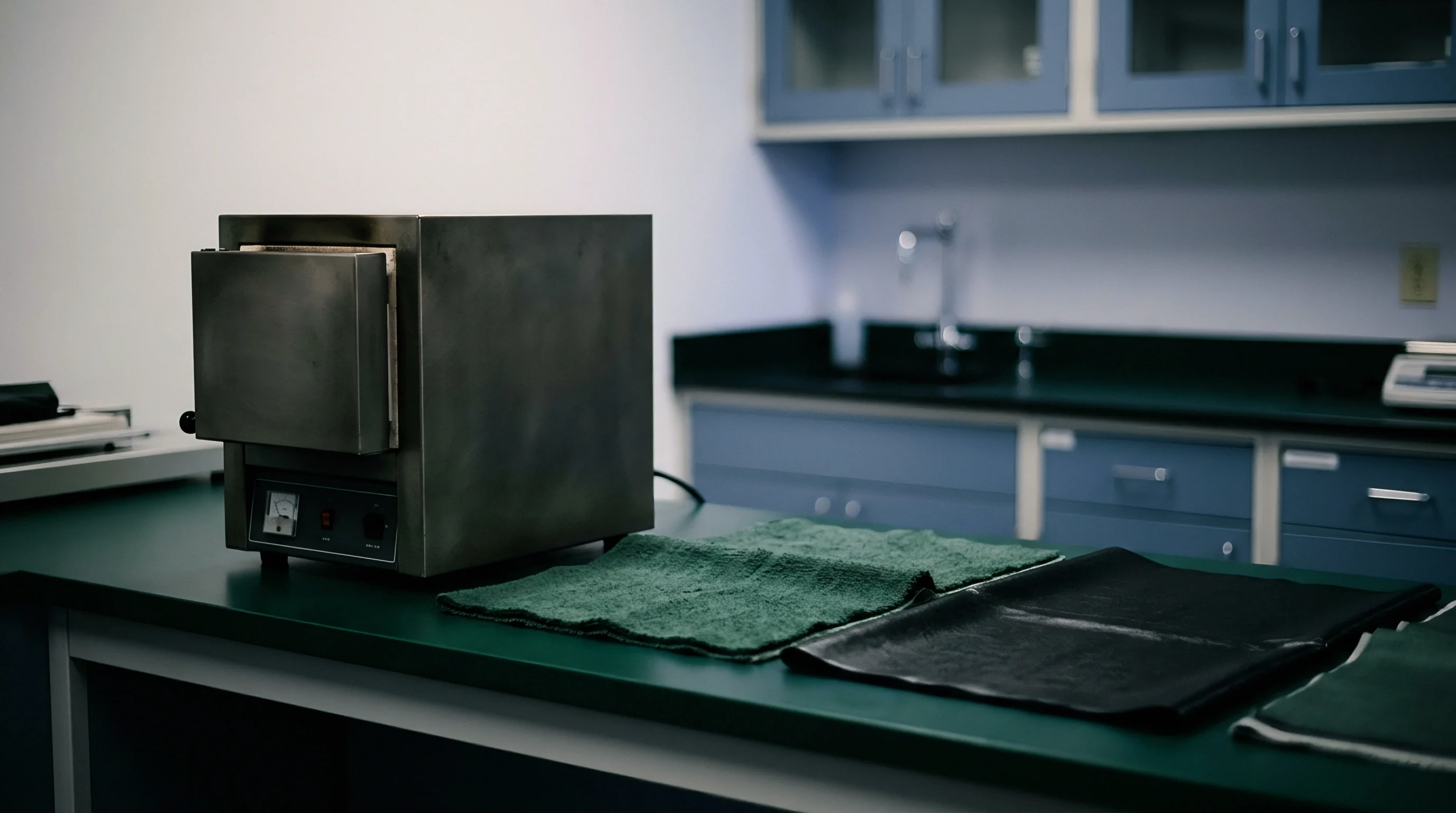
Bench testing of diffusion parameters relies on climate chamber exposures coupled with embedded sensor arrays. Fiber classers and spinning auditors validate numerical models against physical measurements collected from test bales. Qualification protocols demand specific boundary verification checks:
- Bulk density verification requires full-volume spatial mapping using ultrasonic density scanners prior to environmental chamber exposure.
- Anisotropic thermal conductivity measurement demands needle-probe insertion along both parallel and transverse fibre axes under controlled temperature regimes.
- Dynamic vapour sorption testing must determine single-fibre sorption kinetics to isolate cell wall diffusion parameters from bulk package transport.
- Multi-point core RH monitoring uses micro-capacitance sensors embedded at varying depths to capture transient moisture propagation fronts.
Field sensors provide reliable validation data only when calibrated across the exact temperature and compaction ranges expected during industrial transport.


Valuation

Commercial Mass Settlement and Moisture Allowances
Financial adjustments in raw flax procurement depend directly on accurate moisture determination. Standard commercial regain for scutched flax stands at 12.0 percent under international trade terms. Invoices modify gross landed weight to reflect clean dry fibre mass plus standard commercial regain allowances.
Excess water shipped inside dense bales represents paid transport weight that turns into process waste during conditioning.
Consider a 40-tonne contract of scutched line flax quoted at 4.20 EUR per kg clean dry basis. If delivered bales arrive with an average core moisture regain of 15.5 percent due to moisture migration during transit, the invoice calculation must adjust gross weight. Excess moisture adds 1,400 kg of water above standard allowance across the shipment.
Correcting invoice weight to standard 12.0 percent regain prevents overpayment of 5,880 EUR on raw fibre mass alone. Inaccurate weights corrupt shipping invoices. Freight costs for moving excess water add further landed cost penalties.
| Delivered Regain (%) | Invoice Weight Adjustment (kg) | Raw Material Cost Delta (EUR) | Hackling Yield Shift (%) | Net Spinable Metre Cost Delta (%) |
|---|---|---|---|---|
| 10.0 | +714 | +3,000 | +1.2 | -2.1 |
| 12.0 | 0 | 0 | 0.0 | 0.0 |
| 14.0 | -701 | -2,944 | -1.8 | +3.4 |
| 16.0 | -1,379 | -5,791 | -4.5 | +8.9 |

Hackling Yield Impact from Thermal Spikes
Overheated bale cores suffer structural degradation of natural pectic binders holding elementary bast fibres into commercial ribbons. Thermal spikes exceeding fifty-five degrees Celsius combined with high moisture content initiate mild thermal hydrolysis of pectin layers. Damaged pectic networks reduce fibre bundle cohesion.
Weakened bundles break excessively during hackling machine operations, converting high-value long-staple line flax into low-value hackling tow.
Hackling yield drops by three to five percentage points when processing thermally degraded stock. Line flax valued at 4.20 EUR per kg converts to tow valued at 1.40 EUR per kg, generating a net value loss of 2.80 EUR per kg on degraded volume. A three percent yield drop across a 40-tonne batch shifts 1,200 kg of line fibre to tow, imposing an immediate material loss of 3,360 EUR.
Contractual limits specify strict regain. Spinners enforce strict moisture and core temperature limits at bale opening to protect overall yarn count economics and mill profitability.