Viscoelastic Dissipation
Time-dependent mechanical behaviors in polymeric materials govern the progressive reduction in resisting stress when held at a constant, fixed strain over time. The mechanism of stress relaxation kinetics characterizes the temporal rate and mathematical trajectory at which internal strain energy dissipates through molecular rearrangement and structural realignment. This kinetic profile applies across all viscoelastic polymers, natural proteinaceous and cellulosic fibers, and woven structural arrays maintained under static geometric deformation.
It ceases to apply once applied deformation fluctuates dynamically, transitioning the physical response into dynamic fatigue or cyclic hysteresis regimes.
Polymer Chain Mechanics
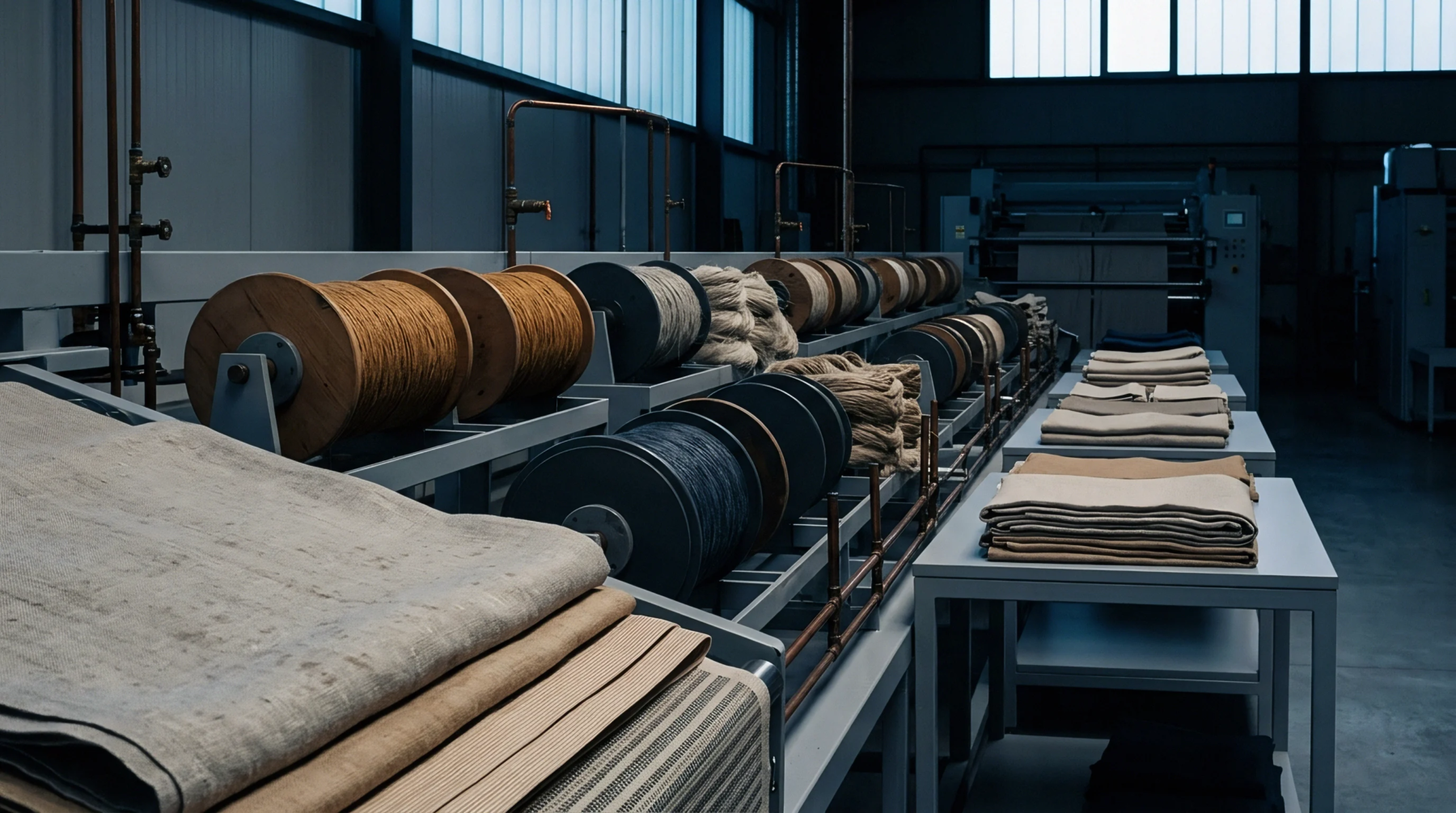
Viscoelastic internal relaxation manifests through the gradual breaking and reforming of secondary polymer interactions under sustained displacement. Within linen manufacturing facilities, stress relaxation kinetics plays a role during package winding, fabric tentering, and sanitary finishing. Flax fibers possess a complex hierarchical architecture composed of highly crystalline cellulose fibrils embedded within an amorphous matrix of hemicellulose and lignin.
When a linen warp yarn is extended to a fixed length on an automated tensile tester, recorded load values drop rapidly over the first few seconds before transitioning into a slower, logarithmic decay. Finely ground flax fibers display pronounced relaxation due to the mobility of non-crystalline regions plasticized by ambient moisture. Chinese mill laboratories model these rates using Maxwell and Kelvin-Voigt mechanical models to determine precise relaxation time spectra across varying relative humidity levels.
During fabric tentering, operators set dwell times in drying chambers according to these kinetic rates, ensuring that processing tensions relax fully while the cloth is held at fixed width. If fabric exits the tenter frame before relaxation completes, unresolved internal stresses drive residual shrinkage during subsequent laundering. Quality technicians check finished fabric lots using standardized relaxation tests, documenting residual tension decay to confirm the stability of finished fabric dimensions.
Dimensional Control
Finished fabric performance relies on the complete dissipation of stored mechanical stresses to avoid dimensional distortion. Inadequate monitoring of stress relaxation kinetics causes skewed warp lines and seam puckering in assembled garments after exposure to water. Finishing plants employ chemical finishing agents and steam decatizing to accelerate relaxation rates within shortened processing cycles.
Textile specifications establish acceptable residual relaxation levels to guarantee that fabrics maintain flat, stable dimensions over extended commercial lifecycles. Precision tracking of stress dissipation dynamics maintains both weave regularity and long-term garment fit.