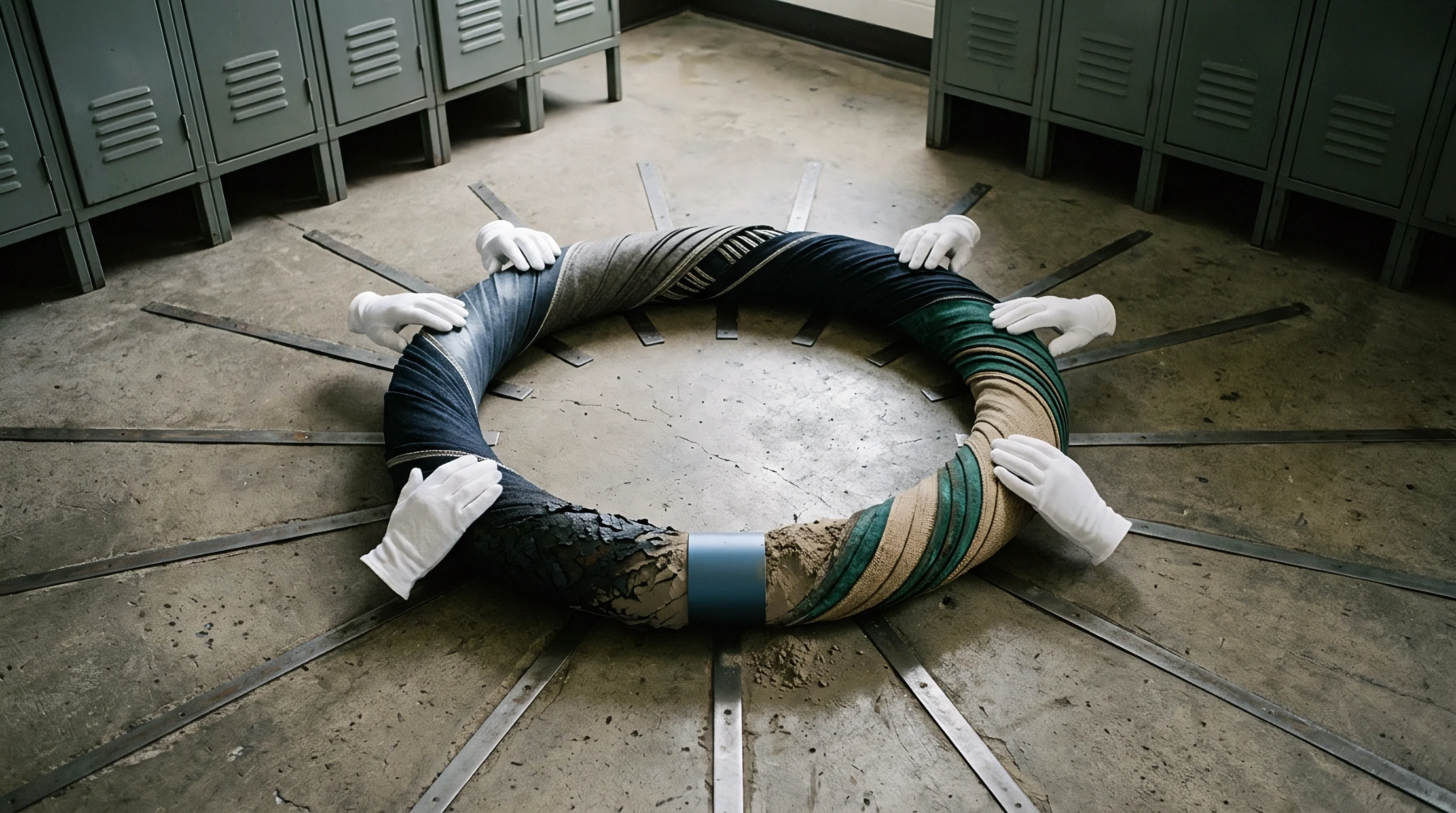
Mechanical Stress
Lateral friction and bending forces exerted by taut warp ends against vertical metal guide wires produce cyclical shear stress profiles across loom beating elements. In high-speed linen cloth manufacture, reed dent shear describes the transverse frictional load imposed on flat steel dent blades during shedding and beat-up motions. Unyielding flax yarns possess irregular cross-sections and minimal elongation, generating sharp contact pressures against reed surfaces during sley reciprocation.
This interaction cuts micro-grooves into dent edges while concentrating shear deformation at dent brazing joints, forcing thin metal blades out of parallel alignment.
Friction Impact
Abrasive linen fibres compound the wear rate along the dent interface, threatening fabric cover and machine durability. As reed dent shear intensifies across wide rapier looms, deflected dents introduce uneven spacing across warp sheets, producing distinct optical striping known as reed marks in finished linen fabric. Sharp burrs worn into abraded dent edges slice into sizing films, stripping protective starch and fibrillating the flax surface.
This abrasion generates flying lint, warp breaks, shed clinging and protracted loom stoppages. Loom technicians monitor dent condition through optical depth gauges during beam changes, replacing worn reed assemblies before grooving exceeds manufacturer wear allowances. Mill specifications mandate chrome-plated or diamond-like carbon coated dents on looms running heavy bast counts to resist this recurring frictional stress.
Clearance Limit
Geometric constraints on dent thickness govern whether shearing forces produce blade deflection or catastrophic blade bucking. When reed air space drops below forty percent in high-density constructions, packing friction escalates nonlinearly, causing dent deformation regardless of metallic coating hardness.