Mechanical Support
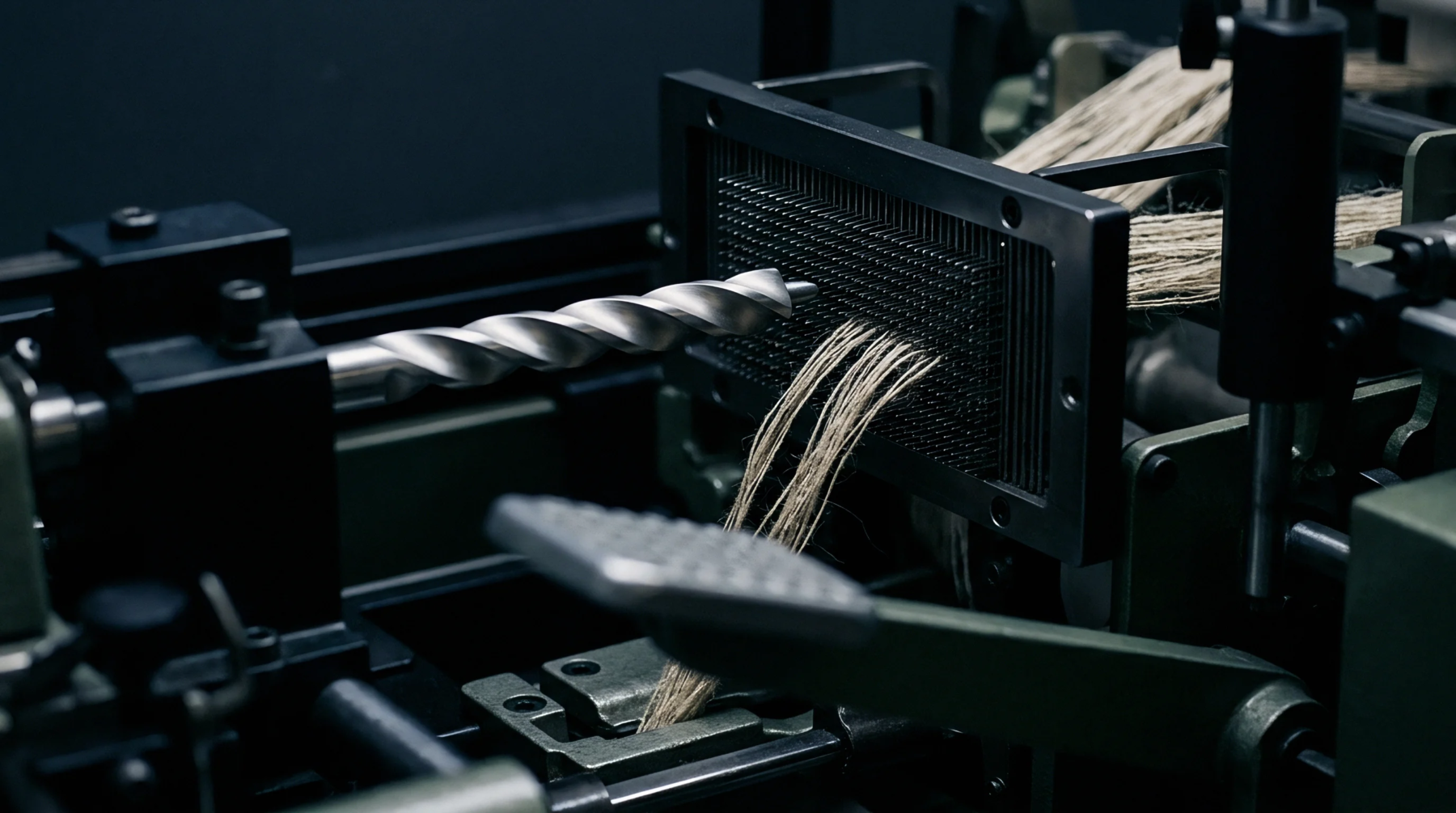
Steel alignment rails define the precise geometry of fibre drawing through the head of a gill box during primary flax processing. A faller gill bed directs the movement of pinned bars that draft the flax sliver into a consistent thickness suitable for spinning. These bars travel through a sequence of screw-driven channels that maintain the vertical orientation of the pins relative to the fibre mass.
Constant tension across the width of the bed prevents uneven drawing, which would otherwise introduce irregularities in the density of the sliver.
Drafting Dynamics
The intensity of fibre separation depends upon the pin density and the speed ratio between the faller bars and the delivery rollers. High pin counts in a faller gill bed improve the parallelism of long-staple linen fibres by removing remaining short particles or neps. A slower bar velocity relative to the intake speed increases the drag applied to the fibres, which assists in orienting those that deviate from the longitudinal axis.
Proper synchronization reduces the occurrence of end breakage during the transition from the pinning field to the drafting zone.
Verification Standards
Inspection protocols require that the vertical clearance between the pin tips and the surface of the faller gill bed remains uniform to ensure even penetration into the fibre bundle. Deviation from this specified gap causes erratic pinning, where excessive force damages individual fibres while insufficient contact permits slippage. Maintenance logs document the replacement of worn bars that lack the required tooth sharpness to grip the linen effectively.
Uniform performance across the entire width of the bed provides the basis for achieving the mass per unit length specified in mill production targets.