Standardizing Gravimetric Regain Corrections for High Temperature Roving Oven Drying
High temperature roving oven drying requires gravimetric regain correction to adjust for non-aqueous volatile loss and balance air buoyancy errors.

Heat
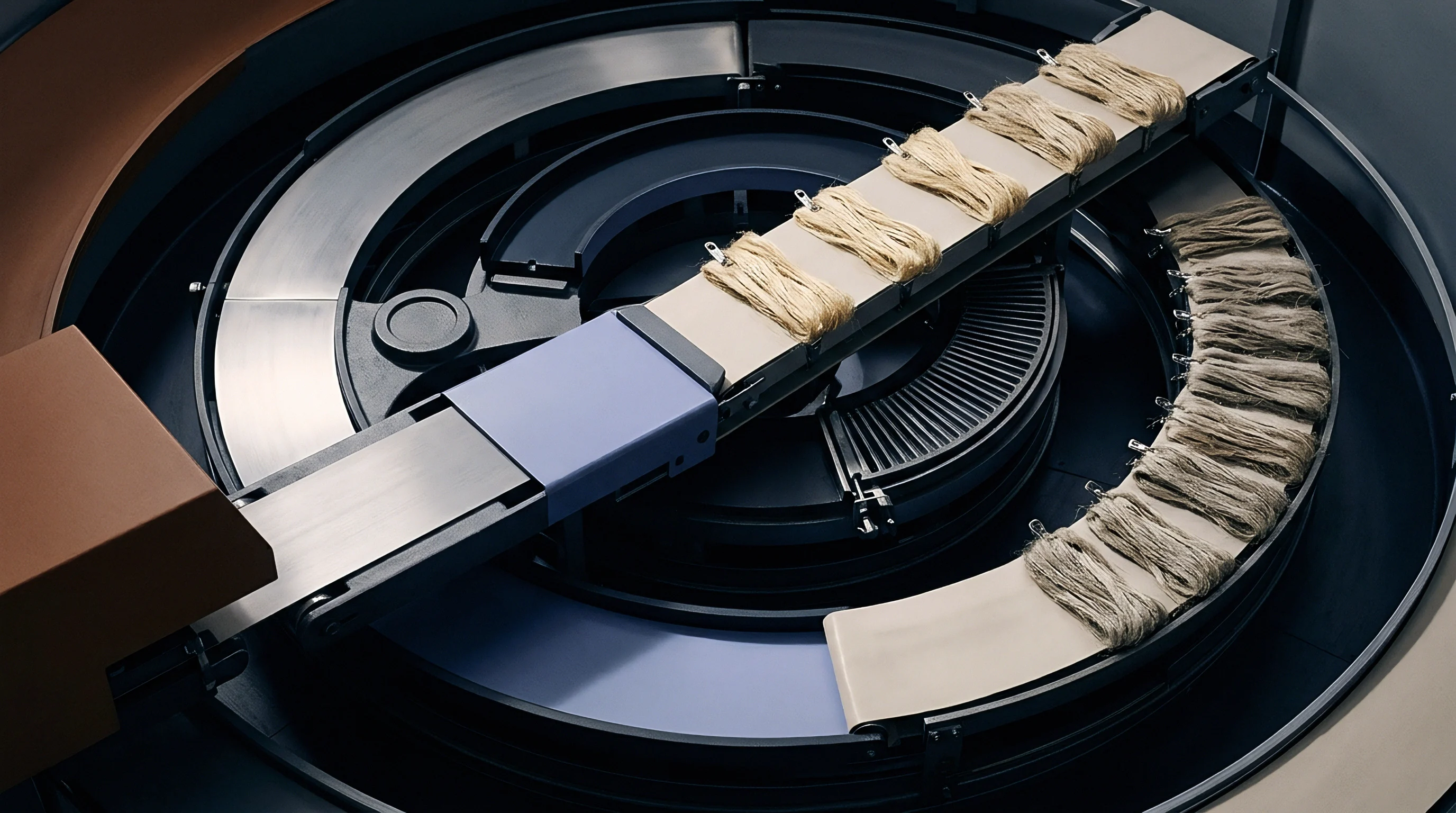
Thermal exposure during rapid gravimetric drying drives off moisture while vaporizing volatile organic compounds inherent to bast fibers. Primary flax roving contains non-cellulosic constituents including pectins, natural waxes, fats, and low-molecular-weight hemicellulose fractions. When forced air inside a drying oven exceeds standard limits, these organic compounds volatilize along with free and capillary water.
Standard laboratory protocols specify 105°C to reach bone-dry mass, yet production testing laboratories frequently elevate oven temperatures to 125°C or 135°C to accelerate sample throughput. Shorter cycle times distort the dry mass measurement by expelling non-aqueous mass, which is then miscounted as evaporated water.
Moisture regain calculations rely on an accurate baseline measurement of bone-dry fibre mass. Because moisture content is expressed as a percentage of initial dry mass, any false inflation of mass loss directly inflates calculated regain. In high-throughput mill environments, roving packages arrive at testing stations carrying residual spinning oils alongside atmospheric moisture.
High temperatures cause thermal cracking and vaporization of these synthetic lubricants together with native flax lipids. Testing at elevated temperatures without a calibrated correction matrix yields erroneous regain percentages that systematically overestimate water content.

Forced Convection Drying Dynamics in Bast Fibre Roving
Airflow velocity and temperature distribution inside drying chambers determine how fast moisture extracts from dense roving bobbins. Dense strand windings restrict internal vapor migration, creating thermal gradients between the outer layers and the core. External layers reach chamber temperature within minutes, starting non-aqueous volatile breakdown while inner strands still hold trapped free moisture.
Standard gravimetric protocols call for continuous mass monitoring until successive weighings display less than a 0.05% change over a fifteen-minute interval. Accelerated heating drives off bound moisture from internal cell walls, but prolonged exposure at high temperatures degrades the primary cell wall matrix.

Non Aqueous Volatilization Thresholds across Processing Temperatures
Organic fractions inside green and scoured flax fibers have distinct thermal decomposition thresholds. Waxy cuticular layers start softening and vaporizing as low as 80°C, though mass loss accelerates sharply once chamber air surpasses 110°C. Pectin networks break down beyond 120°C, releasing bound water and gaseous pyrolysis products. The table below details mass loss distribution between water and non-aqueous organic compounds across increasing oven temperatures over a thirty-minute exposure period.
| Oven Temperature | Exposure Time | Aqueous Water Loss | Volatile Lipid Loss | Non Aqueous Mass Shift |
|---|---|---|---|---|
| 105°C | 60 min | 11.82% | 0.08% | 0.08% |
| 120°C | 30 min | 11.84% | 0.26% | 0.26% |
| 130°C | 20 min | 11.85% | 0.48% | 0.48% |
| 140°C | 15 min | 11.85% | 0.81% | 0.81% |
Mill laboratories running uncorrected high-temperature cycles record dry mass figures that include non-water mass loss. A sample losing 0.48% of its initial weight to volatilized waxes yields a calculated regain reading roughly 0.55 percentage points above the true moisture state. Across commercial shipments, this discrepancy alters invoice weights and distorts technical processing parameters in downstream spinning operations.
Uncorrected volatile loss in high-temperature gravimetric drying inflates calculated moisture regain by expanding perceived water mass loss beyond actual moisture content.
Failing to standardize gravimetric corrections for thermal volatility shifts the financial burden of phantom mass onto downstream buyers, who end up paying yarn prices for lost organic plant material.

Calibration
Precision weighing systems mounted within or adjacent to high-temperature drying chambers require rigorous mechanical and thermal stabilization. Convection currents from high-power heating elements exert upward hydrodynamic force on sample pans, altering balance readings during active heating cycles. Buoyancy effects lower air density inside the heated chamber, introducing systematic measurement offsets that vary non-linearly with chamber temperature.
Analytical balances integrated into automated roving drying systems require tare calibration under operational thermal equilibrium rather than at ambient room temperature.
Transferring dried roving specimens from high-temperature ovens to external analytical balances introduces immediate moisture re-absorption risks. Ambient air inside testing facilities sits between 45% and 65% relative humidity. Bone-dry flax fibers absorb atmospheric moisture within seconds of exposure, making unsealed transfers inaccurate.
Sealed desiccator jars prevent moisture uptake during cooling, but cooling takes thirty to forty-five minutes per sample, bottlenecking mill operations. Direct internal load-cell weighing eliminates transfer delays, though it requires precise compensation for thermal expansion of weighing pans and mounting hardware.

Chamber Air Buoyancy and Load Cell Zeroing Protocols
Air density shifts inside a sealed chamber heated to 130°C create a net positive lift force on test containers. Zeroing a gravimetric apparatus at ambient 20°C results in a lower dry sample mass reading during operational heating if the tare value is not adjusted for hot air buoyancy. High-performance drying units use water-cooled balance pedestals and continuous airflow control to stabilize local density above the weighing pan.
Calibration routines apply dynamic offset factors to compensate for both aerodynamic drag from forced circulation and air density differences between internal and external environments.

Standardizing Desiccator Cooling against Inline Weighing Methods
Verifying balance stability under continuous operational conditions requires a standardized step-by-step validation procedure. The sequence below outlines the protocol for establishing verified dry-weight equilibrium within elevated-temperature testing units.
- Preheat the drying chamber and internal sample holder to the target temperature of 130°C for at least forty-five minutes to achieve complete thermal stabilization.
- Execute automated electronic tare zeroing on the empty sample basket under full operational forced air circulation velocity.
- Place the calibrated stainless steel reference mass into the sample basket and record displayed mass at one-minute intervals across twenty minutes to confirm thermal stability of the load cell.
- Introduce the pre-weighed roving specimen into the sample basket, securing the basket closure to prevent mechanical sample displacement from convection currents.
- Initiate continuous mass logging at thirty-second intervals until three successive readings display a mass delta under 0.001 grams.
- Record the raw bone-dry mass, apply temperature-specific buoyancy correction factors, and document ambient humidity conditions inside the balance housing enclosure.
Systematic verification prevents electronic drift and aerodynamic lift from corrupting raw weight readings. Rapid cooling in ambient air is often assumed to introduce negligible error, leading to omitted desiccator transfers or buoyancy compensations under tight time constraints.


Formula
Deriving standard regain requires separating true moisture mass loss from thermally induced volatile organic mass loss. Standard commercial regain calculations assume all weight lost during drying represents pure water. The official moisture regain percentage, denoted as Ro, derives from initial specimen mass m0 and uncorrected bone-dry mass md.
Ro = left( fracm0 – mdmd right) × 100
When elevated drying temperatures drive off non-aqueous constituents, measured dry mass md falls below true bone-dry plant mass mdry. The non-aqueous mass loss fraction, designated as α, functions as a coefficient of temperature T and exposure duration t. Correcting dry mass yields the true physical moisture regain value Rcorr.
mdry = fracmd1 – α(T, t)
Rcorr = left( fracm0 – mdrymdry right) × 100

Deriving Thermal Volatile Mass Correction Matrices
Establishing accurate α values demands baseline calibration using solvent extraction and standard low-temperature vacuum desiccation. Petroleum ether extraction measures removable wax and oil content, while standard 105°C oven drying isolates baseline moisture loss. Comparing standard 105°C dry mass against 130°C accelerated dry mass provides empirical volatile loss coefficients across specific roving processing grades.
The matrix below defines empirical correction values for unbleached, wet-spun flax roving dried across various thermal parameters.
| Oven Temperature | Roving Linear Density | Residence Time | Volatile Factor (α) | Regain Deduction |
|---|---|---|---|---|
| 110°C | 600 tex | 45 min | 0.0012 | 0.14% |
| 120°C | 600 tex | 30 min | 0.0028 | 0.32% |
| 130°C | 600 tex | 20 min | 0.0045 | 0.52% |
| 140°C | 600 tex | 15 min | 0.0078 | 0.90% |

Worked Calculation for Roving Regain Adjustment at Elevated Temperature
Consider a commercial consignment sample of unbleached wet-spun flax roving weighing 500.00 grams (m0). Rapid gravimetric drying at 130°C for twenty minutes yields an uncorrected dry mass reading (md) of 442.50 grams. Standard calculation without volatile correction yields an apparent regain reading:
Ro = left( frac500.00 – 442.50442.50 right) × 100 = 12.99%
Applying the empirical volatile loss factor α = 0.0045 for 130°C exposure corrects the dry mass determination:
mdry = frac442.501 – 0.0045 = 444.50 grams
Recalculating moisture regain using corrected dry mass produces the actual physical moisture percentage:
Rcorr = left( frac500.00 – 444.50444.50 right) × 100 = 12.49%
Applying an empirical thermal volatile correction factor lowers calculated regain by 0.50 percentage points, bringing high-speed test results into alignment with standard reference methods.
Contractual sales agreements referencing ISO 6741-1 mandate that commercial mass reckonings incorporate verified dry mass corrections whenever testing conditions deviate from standard 105°C equilibrium reference drying.

Tolerance
Commercial transactions across international markets depend on strict compliance with specified moisture limits. Standard commercial moisture regain for flax yarn and roving is internationally fixed at 12.00% under normal atmospheric conditions. Billed weight calculations adjust actual net weight based on measured regain versus standard allowance.
Allowable tolerance windows between buyer and seller testing laboratories typically span ±0.50 percentage points around declared regain.
Discrepancies exceeding allowable tolerances trigger financial claims, batch re-testing, or shipment rejections. When seller laboratories use uncorrected 130°C drying while buyer laboratories run standard 105°C conditioned drying, systematic variance emerges. The seller’s laboratory reports artificially inflated regain, charging the buyer for water weight that does not exist, while incoming testing by the buyer shows lower regain, generating commercial friction over actual dry fibre content.
Inter Laboratory Variance in Commercial Invoice Mass Reconciliations
Variations in laboratory equipment design, ambient relative humidity, and drying temperature create inter-laboratory spread. Round-robin testing shows uncorrected high-temperature ovens introduce inter-laboratory standard deviations up to 0.42%, compared to 0.11% for standard reference drying. Implementing standardized temperature-dependent regain correction matrices reduces high-temperature laboratory variance back to acceptable reference thresholds.

What Causes Uncorrected Regain Disputes in Fiber Consignments?
Uncorrected regain disputes stem from systemic testing deviations between origin spinners and destination processing facilities. Identifying primary failure modes enables mill managers to tighten testing protocols.
- Inconsistent Temperature Monitoring across sample chamber zones causes non-uniform volatile release throughout dense roving structures.
- Omission of Processing Oil Extraction adjustments skews dry mass figures when spinning lubricants vaporize at elevated test temperatures.
- Uncalibrated Balance Buoyancy Effects shift zero points during active chamber heating cycles, generating baseline mass errors.
- Abbreviated Drying Cycles interrupt mass loss monitoring before true thermodynamic equilibrium occurs, leaving internal bound water unevaporated.
- Atmospheric Moisture Reabsorption during open-air sample transfers from oven to balance corrupts post-drying mass measurements.
Uncertainty remains regarding the exact chemical kinetics of pectin volatilization during rapid three-minute infra-red drying cycles across various flax cultivars.


Dossier
Traceability and quality compliance systems demand complete documentation of gravimetric testing parameters. A transaction certificate asserting certified fiber origin or organic compliance loses integrity if invoice mass calculations rely on flawed laboratory methodology. Technical testing dossiers must record raw sample mass, chamber operating temperature, exposure duration, applied correction factors, and final corrected bone-dry weights.
Linking standardized laboratory records directly to batch lot numbers ensures auditability across complex supply chains.
Customs authorities and trade compliance auditors scrutinize commercial invoice weights for tariff classification and non-preferential origin verification. Inaccurate moisture deductions alter declared net dry weight, impacting valuation and duties under Harmonized System heading 5301 and 5306. Complete testing documentation verifies that commercial mass adjustments conform to international trade standards like ISO 6741.

Integrating Corrected Dry Weights into Chain of Custody Records
Digital traceability platforms require standardized data input structures to process laboratory test reports. Data structures for test results must log both raw oven parameters and corrected gravimetric values. Qualification protocols for sourcing managers evaluate whether supplier laboratories use validated correction matrices for high-temperature testing.
The selection criteria below guide formal assessment of mill laboratory gravimetric testing capability.
- Documented Oven Temperature Profiles demonstrating spatial uniformity across sample racks within ±1.5°C of target operating temperatures.
- Validated Solvent Extraction Records identifying non-aqueous volatile content across specific raw material batches.
- Traceable Balance Calibration Certificates issued by accredited ISO 17025 testing authorities within the preceding twelve months.
- Standardized Correction Factor Matrices integrated directly into automated laboratory management software for instant regain adjustment.
- Audit Trail Integrity Records locking raw mass data entries against manual operator modification prior to commercial invoice generation.
Commercial mass settlement calculations compare declared gross shipment mass against laboratory-verified dry mass plus standard commercial allowance. The table below illustrates financial exposure resulting from uncorrected high-temperature drying errors across a twenty-tonne flax roving consignment priced at 8.50 USD per kilogram net dry mass.
| Test Protocol | Measured Regain | Calculated Dry Weight | Billed Commercial Weight | Financial Settlement Delta |
|---|---|---|---|---|
| 105°C Standard Method | 12.00% | 17,857 kg | 20,000 kg | Baseline Standard |
| 130°C Uncorrected Oven | 12.85% | 17,722 kg | 19,848 kg | -$1,292 USD |
| 130°C Corrected Matrix | 12.05% | 17,849 kg | 19,990 kg | -$85 USD |
Standardizing high-temperature regain corrections aligns physical inventory metrics with financial accounting, preventing multi-thousand dollar invoice discrepancies on bulk fibre consignments.

Contractual Audit Provisions for High Temperature Moisture Protocol
Purchase contracts covering technical flax roving must explicitly define testing protocols for moisture verification. Contracts specify reference oven temperature, maximum allowable heating rates, and mandatory correction factors for accelerated methods. Clear protocol definitions eliminate ambiguous claims during commercial mass adjustments.
Master supply agreements mandate that third-party arbitration testing employs ISO 6741-1 standard reference drying at 105°C whenever laboratory discrepancies exceed contractual tolerance thresholds. Downstream yarn converters audit supplier test reports to confirm gravimetric corrections are applied to all rapid oven determinations before final billing.