Non-Newtonian Attenuation Kinematics
Shear-thinning rheological resistance governs the controlled slippage of lubricated fibre bundles through mechanical drafting zones. Pseudoplastic friction drafting describes the process where liquid or gelatinous agents exhibit reduced viscosity under increased shear rates, allowing flax roving to attenuate into fine yarn assemblies without fibre breakage. This mechanical mechanism defines the boundary between uncontrolled fibre clamping and smooth inter-fibre sliding, ceasing to control fiber movement when drafting speeds drop below the shear-thinning threshold.
Drafting zone calibration charts record speed ratios, roller pressures, and fluid friction coefficients for this operation.
Attenuating Displacement Mechanism
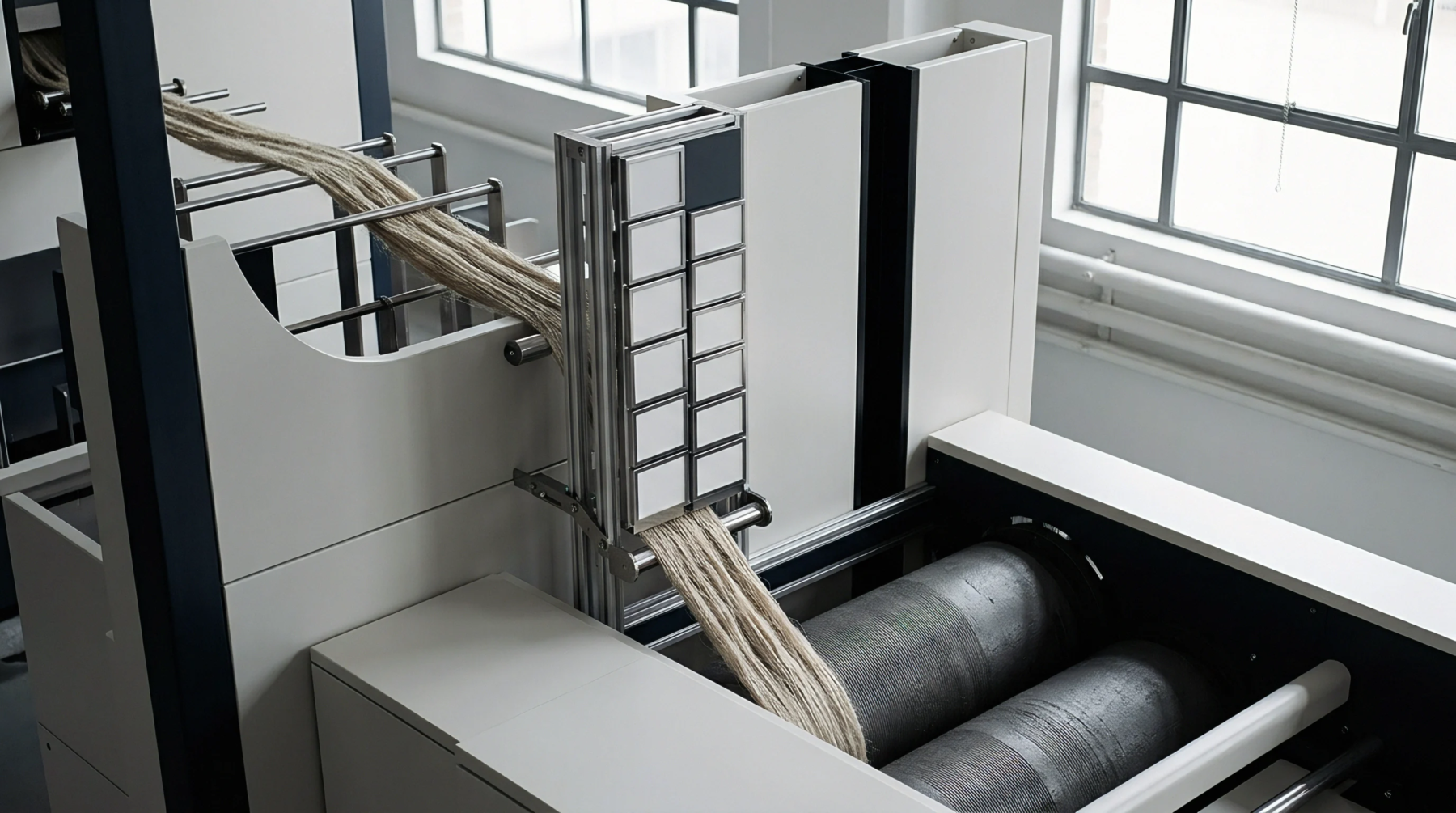
Roving enters the wet spinning drafting unit saturated with hot water or conditioning lubricants. As pairing draft rollers impart shear forces across the wet flax strand, the inter-fibre pectin layer yields to applied displacement. Viscosity drops along the inter-fibre plane as shear velocity increases between the feed and delivery rolls.
Pectins and hemicelluloses, plasticized by hot liquor, act as pseudoplastic fluids that ease individual elementary fibres past one another. The mechanical draft ratio establishes the longitudinal displacement, thinning the strand uniformly without snapping individual flax fibrils. Cold spots or lubricant depletion reverse this effect, increasing local shear resistance and causing sudden yarn breakage.
Spinning Regularity Criteria
Regular attenuation directly controls the mass variance profile of the output yarn. Failure to sustain correct drafting shear yields irregular thick and thin sections, recognized as roving slippage or unattenuated yarn slubs. Mills verify drafting performance using capacitive evenness testers and offline mass variation diagrams.
Spinning line documentation notes roller nip pressures, delivery speeds, and fluid temperatures to maintain optimum shear-thinning behavior throughout the shift. Achieving targeted drafting consistency secures the low irregularity numbers required for high-grade fine linen yarns.