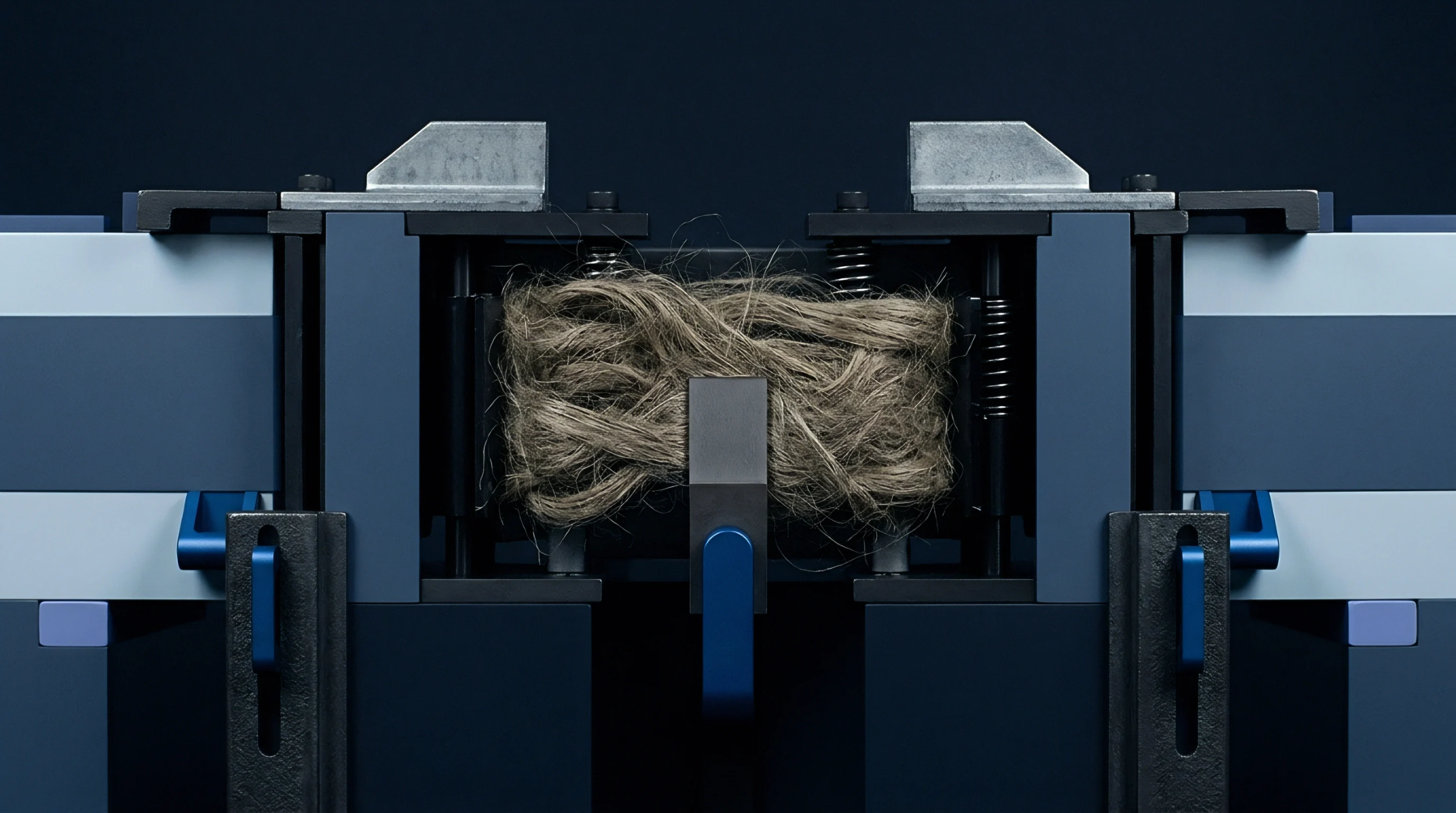
Structural Distortion
Geometric variance occurs when a lattice undergoes shifts that alter the relative distance between internal points through local displacement rather than uniform rotation or scaling. Non-affine deformation appears in textile mechanics when specific fibre bundles within a woven sheet experience localized buckling or shear slippage that the surrounding matrix does not share. This phenomenon creates an inconsistent distribution of strain across the fabric surface which complicates the predictive modeling of material behavior during mechanical processing.
Quality control personnel quantify these inconsistencies by comparing the measured local coordinate shift against the theoretical linear projection of an ideal state. Variations that exceed the tolerance thresholds noted in the mill acceptance criteria indicate a failure in the structural integrity of the base material.
Process Disruption
Spinning and weaving stages rely on the assumption of uniform material response to mechanical tension and pressure. Non-affine deformation breaks this regularity and forces the machine operators to adjust input parameters to prevent permanent damage to the yarn integrity. Technical engineers monitor the tension distribution using high resolution optical sensors that detect localized puckering in the finished weave.
If the sensors identify areas where the local displacement exceeds the expected value for a particular weave density the system flags the batch for secondary inspection. Excessive instances of these irregular displacements often result in the rejection of a lot due to the inability to maintain uniform dye penetration during the finishing phase. Finished cloth with high levels of this condition shows poor handle and reduced durability for industrial applications.
Analytical Variance
Measurement protocols for textile assessment require the mapping of point cloud data from the fabric surface under load. Non-affine deformation enters the calculation as a residual error after the application of a global affine transformation to the raw data set. Analysts define this residue as the degree of divergence from perfectly predictable elastic movement within the molecular network of the flax fibres.
The presence of high residuals identifies regions of internal stress concentration that weaken the final textile product. Correct identification of these zones allows the production teams to refine the fibre preparation steps to ensure better alignment of the internal geometry before the loom process begins. Detailed analysis of the underlying causes confirms that the material composition effectively dictates the magnitude of this mechanical inconsistency.