Attenuating Operation
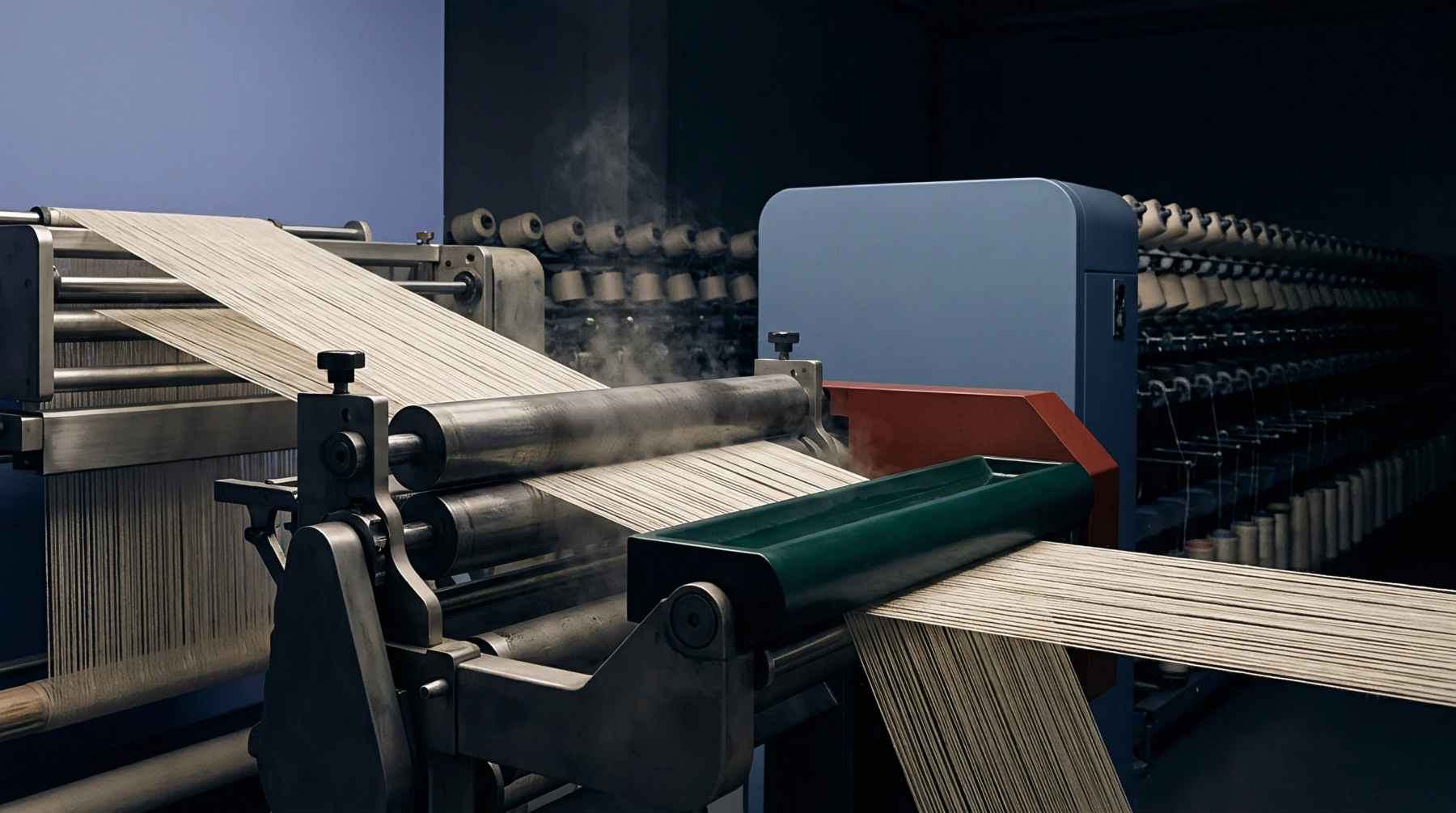
Mechanical attenuation of combined sliver strands progressively reduces linear mass density while straightening fiber assemblies along the machine axis. This processing stage, termed draw frame drafting, utilizes consecutive pairs of drafting rollers operating at differential surface velocities to pull flax slivers down to a uniform cross-sectional size. The process operates between wet flax carding and rover spinning preparation in linen processing mills.
Multiple card slivers enter the rear roller nip together, pass through faller bars or intermediate control aprons, and exit through front delivery rollers running several times faster than back rollers. The draft ratio defines the mechanical elongation applied to the fibrous mass across the processing zone. The mechanical boundary of the operation ends where cohesion between individual fibers breaks down, leading to drafting wave faults or sliver separation.
Grip Geometry
Drafting zones utilize weighted top rollers and fluted steel bottom rollers to hold bast fibers firmly without crushing fiber walls. Heavy roller weighting prevents slippage of long flax strands, which exhibit significantly higher drafting resistance than soft cotton fibers. Faller pins or gill bars penetrate the moving flax web between roller nips to constrain fiber movement, preventing floating fibers from accelerating prematurely.
Drafting wave generation appears whenever short fibers lose frictional contact with adjacent bundles during acceleration toward the delivery roller. Mill technicians verify nip-to-nip distances on drawing machines to match the fiber length distribution of the processed flax lot. Drawing sliver monitoring forms record roll pressure, mechanical draft gears, and nip spacings for every processing shift.
Insufficient nip clamping allows whole fiber bundles to pass unattenuated, forming thick defects called draw frame lumps that persist into spun yarns.
Evening Effect
Doubling represents the primary mechanical method for eliminating periodic variations introduced during initial carding stages. Feed creels deliver six to eight card slivers simultaneously into the drafting head, merging separate mass inputs into one unified fibrous strand. Mechanical draft gears set the front roller speed to attenuate the collective bundle by a factor equal to the number of fed slivers.
Periodic weight variations cancel out across the combined strands according to statistical law, diminishing overall variance. Process engineers measure output consistency by running slivers through capacitive testing equipment, recording mass variation as a percentage value. Roving frames receive the drawn slivers, utilizing the improved fiber parallelization to spin high-count yarns without excessive breakages.
Output sliver uniformity limits depend directly on the precision of draft ratios and the uniformity of incoming card slivers. Precise mechanical adjustments during draw frame drafting determine the ultimate yarn count limits achievable from processed flax batches.