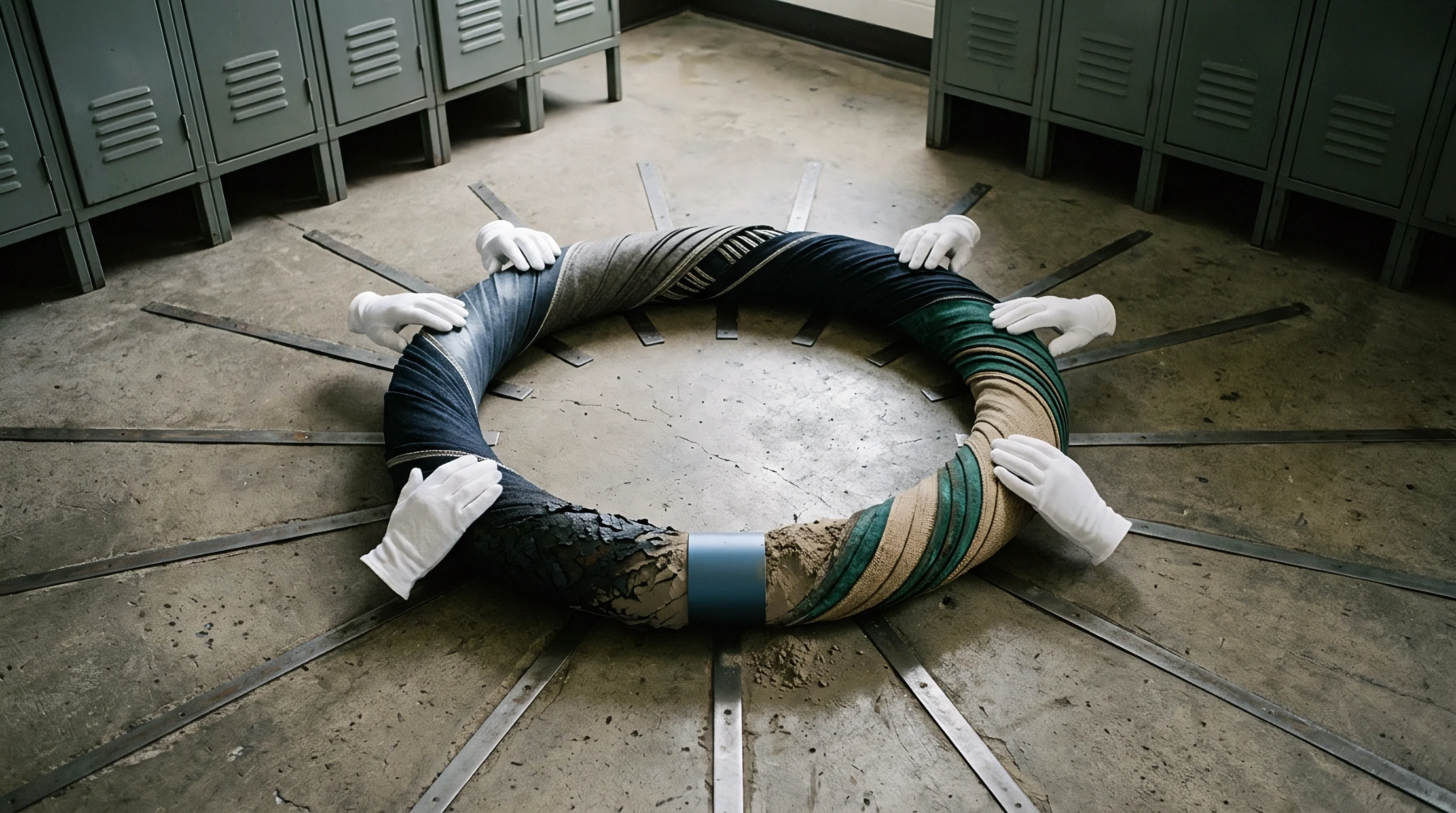
Structural Dimension
Mechanical reduction occurs inside the finishing hall after wet processing completes and before final folding takes place. Constitutive relaxation defines the internal state where wet stretched yarn networks return toward their dry geometry by shedding elastic energy stored during tensioning. Chinese mills record this property within the finishing batch sheet under residual shrinkage limits.
Buyer acceptance criteria demand stable dimensions following home laundering, whereas mill standards enforce strict tolerances on warp-wise retraction prior to cutting. Internal yarn friction resists immediate dimensional recovery, requiring precise ambient moisture control during the drying cycle.
Thermal Recovery
Steam treatment accelerates internal chain mobility within cellulose structures by weakening hydrogen bonds temporarily. Constitutive relaxation proceeds rapidly when moist heat allows disordered microfibrils to settle into lower energy configurations. Operators regulate cylinder temperature profiles to prevent surface glaze while heat transfers through the heavy fabric weight.
Excessive drying speed arrests the recovery process prematurely, leaving residual stresses that trigger later distortion during garment assembly.
Mechanical Constraint
Tension frames apply controlled overfeed during continuous drying runs to compensate for natural dimensional loss. Constitutive relaxation relies on precise mechanical restraint to prevent uncontrolled skewing across the cross-machine direction. Finished linen bolts undergo laboratory wash testing to verify that final residual variance remains below agreed commercial thresholds.
Uncontrolled tension during winding produces permanent distortion that violates export specification limits.